Showing posts with label the struggle. Show all posts

Monday, February 23, 2009

the struggle (part 2)


Ad Reinhardt, Untitled (1960-1966)

there is no salvation outside of History.

they were told in the garden that if they ate of the fruit of the tree they would surely die. to be like god, knowing good from evil, this is politics and the beginnings of all war. every city is babel.

in a broken world, one must write broken sentences.

if the world were perfectly closed there would be no hope. because it is broken one can hope, for that means there is passage beyond what we are.

politics substitutes the borders of the de-personal state and the declaration of war that leads to the rape and plunder of all its subjects for the caress of the body, the communion of love and the worship of that by which love is made possible.

moses was told that no one could see god and live. so, since he was moses, he did not see god. but he misunderstood: we must be no one.

-LoA

Sunday, February 22, 2009

the struggle

prayer in the desert
Jean-Léon Gérôme, "Prayer in the Desert" (1864) [oil on panel]

the labor of writing is not that of trying to get the words out of oneself, as if it were an exorcism. it is instead a matter of trying to find one's place within the words. this immersion is difficult because we do not know how to rest.

while the anorexic desires nothing as if it were something, the ascetic desires even less and thereby attains the Whole.

an individual: a shadow of what one is meant to be

whoever desires the infinite but sets aside the finite will only find themselves mired in finitude because they have insisted that the infinite is limited. but the one who immerses themselves in the finite will find it transfigured and every limit removed.

war: the belief that death is a greater good than peace

a standing army that sits unused is a waste. a standing army that is used is a waste.

a definition of theology: thinking through sin in the hope of salvation

-LoA

Thursday, February 21, 2008

height (concerning vertigo)


Christopher Cousins, "Unadherence" (2007)


beyond vertigo, faith is to find oneself in the grip of height and without ground. this can be confused with vertigo since, in the disorientation and fear that inevitably follows, one feels as if one might plunge into the abyss. yet vertigo is a desperate attempt to cling to self-control when in the grip of height, fearing that one may step off the edge, might lose one's footing. but beyond fear, peace will be the recognition that one was never simply one's own, and has not been plunged into the abyss. there can be, in the grip of pure height, no fall, because the height has no limit: one is actually in perfect rest. recognizing that one is at a height beyond all abyss is the constant challenge of faith. this is why there is despair even in faith: one wonders if one is not truly falling, and if one will ever truly learn to rest.

-LoA

Monday, December 24, 2007

birth: five propositions for meister eckhart on christmas (the struggle, part 8)


Arthur Hughes, "The Nativity" (1858)


mary gave birth to Truth so that the Truth might be made universally incarnate in us.

until the event of Truth is universally incarnate as History, nothing is Whole (adorno: "the whole is the false").

Truth must be realized in order to be Whole, therefore we must give birth to Truth.

mary is the last moment before the initial realization of Truth. mary realized that she was nothing and thus she was set free to be the event of the birth of Truth: the one whose heart had the fecundity of virginity and the purity of motherhood. but beyond mary's insight, one must realize that the consummation of the nothing is Truth and that the Truth is not-other to the nothing. this is incarnation.

today, we too fail to grasp the possibility of the Whole-of-History (Peace). but perhaps like mary we can realize that we are nothing ("let it be done to me as you will") and thus be the site in which Truth is born. therefore let us be the nothing out of which the Truth creates History.


-LoA

Monday, July 9, 2007

communio sanctorum (a meditation on bonaventure's triple way iii,1)

<
Marc Chagall, "Adam and Eve" (1912)

If we desire Peace, then we must somehow surpass the brokenness of the present. But the path beyond is not an arbitrary one, nor is it chosen in a kind of unrestricted freedom: no decision is ever made solely in the moment. History gave us birth, and it is out of that inheritance that the possibilities for action are given to us. To ignore this is not merely a self-defeating turning against oneself, it is a heretical declaration that one is absolute in their sovereignty. There is no future without recovery of the past. But likewise, History reveals that we never act alone. Not only must we act in partnership with those with whom we journey now. The pursuit of Peace is also undertaken in communion with those who have gone before us, who we must never forget because they too still desire Peace. The struggle now always models itself on those who were faithful in the struggle before.

-LoA

Tuesday, June 5, 2007

freedom: a meditation on bonaventure's breviloquium v.1-3


Dale Frank, "(Goodnight Scrub)" 2003


there is a tendency to think of freedom as the ability to do what one wants, the autonomous exercise of one's individual will; the exercise of one's own power. but this seems incredibly problematic, for what is it that is ours? what do we have that is not a gift, down to our ability to act, and existence itself? in and of ourselves we are nothing, our existence was never ours to command, nor can we will our non-existence. we find ourselves absolutely dependent on a power beyond our mere individuality. and because we are nothing of ourselves, what is the operation of this autonomy which pretends to freedom except the will-to-nothing, the impossible desire for self-annihilation. our will no less than our existence is received from that which is beyond us: from our history, from culture and from that by which even they are.

to fight against this is not to assert one's freedom, but to deny one's reality within the Whole and thus become a slave to the forces one fights against. we delude ourselves that our freedom is somehow our's, a possession that belongs only to us. but this is never so. perhaps the mistake is understandable. my existence is out of my control; i find myself existent from beyond my will in an event that can only be, from my standpoint, fully gratuitous. but surely my actions are mine own. and indeed they involve my reason, my will: freedom. yet, it is no less true of my freedom than it is of my existence itself that it is received as a gift, for my freedom is a mode of my existence.

because we are, of ourselves, nothing, human freedom left to itself is only capable of nothing. it is only by way of that same gratuity by which we find ourselves to exist that we are able to act with meaning. individualism, egotism, self-will is a turn away from meaning toward nihilism and self-destruction. the very gratuity by which we are is also the guarantee of meaning-full action, the fact that we are caught up in something larger than ourselves. freedom is not, then, self-will, but bringing oneself into conformity and identification with the Whole by which we are free.

-LoA

Wednesday, April 25, 2007

universal crucifixion


Irena Korosec, "Kurds, Forgotten by God" (2004)


let the blood be on our hands, and on the hands of our children

one can only turn the holocaust into a unique event, a sacrosanct atrocity, by a stubborn and studied act of forgetting: a forgetting of history, a forgetting of a history of blood, a forgetting of murder; and this forgetting is itself a form of murder. genocide is a political crime because it divides us by some party, some ethnos (some genos). but by grouping us genostically one has already begun the process of dehumanizing the other so that one can kill more easily. murder is much more the unthinkable – it puts the blood on my hands and makes the killed my responsibility: one i am forced to address by their first name, their good name – the stranger is made my neighbor when there are no nations to reduce the address to a tribal identity. personal crimes – the only crimes against humanity. politics is always already such a crime.

-LoA

Monday, April 9, 2007

the struggle, part 11 (on easter)


Matthias Grünewald, "The Resurrection" (1515)

the resurrection ought not to be understood as a miracle, but as the actualization of what we have always understood to be the idea of existing. to exist (ex-sistere) is simply to transcend one’s moment toward another, rather than remain unmoved by the flow of time, which is nothing like existing or even living. to exist is the inability to remain content with what one is and the need to exceed nature.

existing at its most basic takes place in the moment to moment. one lives in an intentionality towards that which is other, towards the next event. but this view is only partial and fails to grasps the wholeness of human existence. to refer to “ex-sisting” recognizes that humanity is more an ek-stasis than a hypo-stasis (sub-sisting). subsistence is to be below the level of life, to dig deep into the animal to find something unchanging, something impervious to time and History, to find something already dead. the very idea of human ex-sistence is to pass beyond itself in the totality of its being: refusing the idolatrous submission to life and death, being and non-being, as if they were the All. resurrection is to realize the intentionality of humanity toward the Beyond.

-LoA

Monday, March 26, 2007

the struggle, part 10


Kimberly Dow, "Charity" (2006)

nudity combines within itself starkness and the voluptuous. this is to say that there is a blinding depth to the human person which is attached to the body. the attempt to separate them is sin: either as a militant war against the body in the name of purity of spirit (mortification), or as a gross consumption which impossibly attempts to reduce the self to fleshliness (decadence). what is truly revealed by the removal of clothing, enacted before the beloved, is that modesty is essentially attached to the body and cannot be overcome, even in an act of violence. the intimacy one has with the beloved is that they recognize this truth.

it is certainly true that fashion is the public language by which we interpret persons with respect to their sex, their gender, their public role, their sexuality, etc. the freedom to remove this before another is the freedom to be have someone recognize the extent to which you are inevitably hidden.

fashion is no mere outward sign. even in nudity, as we lay aside the clothes-of-the-day, they remain attached to us, drawing attention to themselves in their absence. precisely insofar as we find ourselves alienated from society, it will be consciously present to us, invading intimacy.

the role and promise of lingerie is this: that social conventions of sexuality will remain attached to her person. they want the acknowledgement that this interpretation of sexuality remains attached to her even in her nudity. to undress will no longer be an act of rebellion against the society which alienates us from ourselves, but a submission to it. intimacy will be a public act, even when alone. it is transformed into the ritual of eroding the distinction between the self and society.

despite all these failures we continue to pursue intimacy with the beloved because it is there that one finds hope that there will have been Peace, that somehow, everything can be reconciled.

-LoA

Saturday, March 3, 2007

the struggle (part 4): reconstructions of karl barth's cd i/1 §1.1


Rina Castelnuovo, "Kibbutz Nahal Oz, Israel, 28 September 2005" (2005) [photograph]


if the struggle for Truth refuses to worship at the altar of the truths-of-the-present-moment, this is because one must take seriously the contradictions within human existence which modernity idolatrously tries to obscure: either through its blind trust in the saving power of technologies (whose accomplishments one has no wish to deny) or the ahistorical self-descriptions of political liberalism and capitalism. the struggle exists; desire drives humanity precisely because the world is not-yet-Whole. it is a response to human brokenness. thus we cannot presuppose we know, always, already, what constitutes wholeness short of its realization, which is our on-going task. and so, the struggle, born of this universal human brokenness and refusing to resign itself to the way things are, acts in the hope of reconciliation-to-come.

there are no secrets, no shortcuts. instead the question of Truth centers on a constant attentiveness to our own being, our own history, which cannot be judged by any external and transcendent standard. we do nothing else but describe ourselves, constantly, through our history, activity and in our brokenness, and in so doing seek the Whole, present-as-hope within those actions.

-LoA

Friday, February 23, 2007

the struggle, part 9 (guilt)

society is an ambiguous beast of which we find ourselves a member and which is, at the same time, something completely other. its failure to engulf me is what allows me to remain me in the face of its overwhelming enormity. i remain, beyond the vastness of a society which i cannot escape and which indeed makes my relations with others possible and meaningful. at the same time, i am never me alone; i am never the autonomous and free self i might wish to be. i am always a being-with-others. this being-with-others is the source of all conscience: con-science: thinking-with-others.

neither piety, nor love of neighbor can do justice to the complexity of these social relations. in love we attempt to seclude ourselves in the privacy of intimate relations so as to avoid the scope of our responsibility. it is true that love is blind: love is blind to those who are beyond the intimacy of the one with whom we have decided to identify and to whom we hold ourselves responsible. nor can we turn directly to god to absolve ourselves of the complexity of the social. the turn toward god, in the attempt to satisfy conscience, is to turn away from one's responsibilities, an attempt to shut out the voice of the many and reduce it to the voice of One that one claims will forgive all. but god is not blind.

we cannot live in such closed relations. and we know this well, unfortunately, no matter how we might try to hide from it. the guilt of conscience has to do with the fact that the meaning of who i am and what i do is not contained nor solely determined by my own intentions. my intentions lead me beyond what i intended into a relationship with the whole of society. in each of our intentions, our actions go out from us, always returning to us another way. they become detached from us and subject to the judgement of others. we become communal. we thus await the judgement of others: others we have never met, who appear as the face of strangers surrounding us in condemnation. beyond love, and all our claims to piety, there is the Whole which comes to us in many faces and whose voice is not one.

-LoA

Friday, December 15, 2006

the struggle, part 6


Felice Sharp, "Markers" (2006) [mixed media on board]


faith is the belief that in and through human activity something more gives itself; a commitment to the idea that there will be a fullness of Truth; that this fullness is the implicit promise carried in the experience of meaning (this is what makes faith a rational hope). it is faith precisely because this fullness is not-yet. thus the object of faith is the Truth-which-is-our-Future.

the claim of faith: out of the Old the New will impossibly emerge.

Truth is not something that simply is. Truth is not a collection of facts. Truth presents itself in and through human activity and because of this one never simply has the Truth. it is instead encountered in the various ways in which human beings examine the question of meaning, and so it is presented with all the partiality and brokenness of humanity. this is the origin of the struggle: humanity's constant attempts to come to the fullness of meaning, the Whole, that is promised in all they do. Truth is not held in the past, nor does it exist as a timeless present as if it were an already fulfilled reality. Truth is the Future which must be realized. This is why History is Truth. we experience Truth as that which is about to come.

hegel claimed that the True was the Whole. adorno countered this with the claim that the Whole is the False. but these two claims are not in conflict with one another. for hegel, Truth could only be known from the standpoint of the fullness of History. adorno reminds us that in the midst of History all claims to possess such knowledge already are occult. claims to grasp what that might be, or to insist that one knows the plan or practice by which progress toward Reconciliation might be certainly achieved is the height of >undialectical= or >uncritical= thinking. it can only serve the interest of whatever totem is raised as a banner of salvation, shutting humanity off from any hope for the Future. today Truth is crucified and broken, and thus all claims to Wholeness, Holiness, Peace or Reconciliation are ideology and mystification. adorno is the truth of hegel as seen in the middle of History.

in the present all writing must make clear that it is an exercise in productive failure.

-LoA

Wednesday, December 13, 2006

ecstasy


Robert Ryman, Untitled (1965)


When Levinas argues in his early essay, “On Escape”, that human desire is not a sign of lack, he seems to be making a radical break with the tradition, both theological and philosophical. The insufficiency of what we have and the need for more, something that could satisfy it, had been a crucial aspect of philosophical theology from Augustine to Maimonides to al-Farabi. We move, are driven by desire, because we want something. But Levinas is not really making as radical a break as it might seem, for what Levinas is here arguing is that humanity does not find its end in itself. When one searches within the given being of human existence one is always left unsatisfied; our natures mock us, hang about us like a weight, keeping us riveted to our own dis-satifaction. While other finite natures find their fulfillment in their own natural capacities, this is untrue of humanity. Fish gotta swim, birds gotta fly, pens gotta write, but humanity must ....nothing. It is not, then, that there is something we lack, instead we need to get out of the very thing we have, indeed we need to escape all having. The erotic drive is the unquenchable desire for transcendence. So when Levinas tells us that there is a disquiet at the heart of humanity that manifests itself naturally as the desire for escape, he is saying humanity cannot be content in its own finitude. Humanity is incapable of achieving its own happiness, and so will be content with nothing less than a breakthrough that it is incapable of bringing about on its own. Here in fact Levinas is advocating a position that can be found throughout the Platonic tradition. Desire can only be satisfied by the Good which is beyond all being and every nature. We are only truly ourselves in ecstasy, that is to say, quite literally, in going-out of ourselves.

Sunday, December 10, 2006

faith (an engagement with karl barth's cd i/1 §1.3)

faith and hope point beyond the present moment and thereby recognize that the Truth is not yet realized in its wholeness. thus faith is the orientation of one’s action towards the Truth-which-is-our-Future. our lives must be lived out of that engagement with the Truth. and yet, just as Truth is not some past event, something given as a fact and possessed to be used as a tool, neither is faith something we can have as our own for it is only given as Truth gives itself in freedom. faith, then, is the event in which humanity is made the mediation of the Truth-which-is-its-Future. this must be insisted against every humanism. because there is nothing which humanity does not receive as gift, one can hardly talk of the Future as the highest impulse of human self-realization. of itself, humanity is nothing and humanism is nihilism: the empty pride of insisting on our own being. the Truth cannot be realized as something that humanity possesses, but as that which claims all of humanity as its own. no method can master the Truth in its free character as event. it is never ours, but takes us as its own by the gift of faith.

-LoA

Friday, December 8, 2006

the struggle, part 5 (fallen)


Marten Valkenborch, "The Tower of Babel" (16th c.)


everywhere we seek reconciliation and find only alienation.

there is only the one sin: to insist that 'I am'. everything else is its symptom.

we do not live in the land of Truth, but we are haunted by it. Truth slips between the shadows of the trees in the night, we hear its sound on the wind, see its footprints in the morning dew. By day it threatens, dancing like a fire among the branches, never revealing itself, but frightening us just the same. we worry that it will come for us: we who banished it. we worry it will pierce us to the heart.

we have built our tower; it stretches to heaven. we named its walls Eternity, and on its foundation engraved the word Nature. let Ramses look upon it and despair.

in babel, we speak only one language; by law every sentence must include the word "I".

History is Truth.

-LoA

Friday, December 1, 2006

dialectic


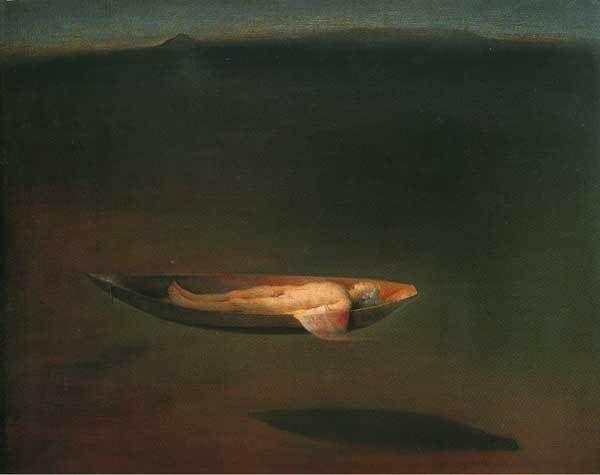
Odd Nerdrum, "Man in Boat" (2003)


the dialectic turns beyond true and the false, the yes and the no, being and non-being, good and evil, morals and ethics, law and freedom, freedom and necessity, reason and unreason, civilization and culture, barbarian and greek, gentile and jew, muslim and kufr, orthodoxy and heresy, burgher and proletarian, male and female, Geist and matter, idealism and materialism, fact and value, form and content, alpha and omega, beginning and end, first and last, election and damnation, hope and despair, one and many, beyond either/or until it arrives at...

-LoA

Tuesday, November 28, 2006

the struggle (part 3)

god is a word, a concept. therefore, just as god is not one, god is not good, god is not beauty, god is not love, god is not being, so also, god is not god.

for st.anselm, the pursuit of truth was a matter of faith seeking understanding. today it is a matter of aesthetics seeking reason.

to speak plainly is a mistake. the discourse of the day numbs one to the reality of the human situation, answers every question before it is asked and chafes at any disruption of its supremacy. but it is merely a tyranny of truth that disguises mutilation. we must mutilate language so that the Truth may appear undisguised.

in a culture unable to see the activity of grace permeating everything, persons are confronted with objective circumstances that are, often, so entrapped within a limited account of practical reason that only an ‘irrational’ act can address the truth of the situation. this is what flannery o’connor calls “a reasonable use of the unreasonable”: the attempt to enter into the real problematic of the object so deeply that the objective contradictions that are everywhere present can actually lead us to truth. this is why the grotesque features so prominently in o’connor’s writings. the grotesque corresponds to the demands of reality and is the tool by which truth shows itself. the genuinely universal and good act is not possible and so the truth is only ever seen indirectly. by exposing the distorted nature of reality, the grotesque act opens up for future action a newer and truer set of possibilities beyond the brokenness in which persons find themselves. reconciliation is only thinkable here and now as the negation of that which is. in this way the very fact of our mutilated being, to which we are so often blind, becomes clear, and gives voice to its desire to transcend its own false-existence.

hobbes argued that in the state of nature we are all equal, because any one can be killed by anyone else. even the strong must sleep. today, life is rapidly becoming ever more natural.

Monday, November 20, 2006

the struggle (part 7)


Katherina Chapuis, Untitled (2004)


anger is madness

pilate asked “what is Truth?” in the hope that by asking the question he could avoid the answer, much as one tries to ward off insanity by asking “am i crazy?”. but it is a mistake to point to the brokenness of being human and take refuge in scepticism as pilate did. instead brokenness is the opening to Truth.

potency
1. powerful, commanding authority, capable of achieving and possessing, forceful;
2. the ability to perform sexually, said of a male
beware, these are not two different definitions

it should not come as a surprise that the site, both geographic and intellectual, which occidentals call the middle east is seen not only as exotic, but as something erotic: a place where sexuality is unleashed in the absence of the civilizing impulse. no matter the truth, the face of this middle east will be the niqaabi. this eroticized vision is a necessary part of western policy towards the region: the world where potency must be demonstrated. the violence and eroticism cannot be separated. so it is no accident that the two constant images that mesmerize the mainstream occidental media are the militant and the restrained, and thus sexually available, woman.

the nomad and the pilgrim are an important bulwark against fascism because they know that home is not a matter of birth, but of ecstasy. this is why it is important to “proclaim that the people must hajj” so that “they will come from the farthest locations.”

a short definition of human nature: ecstasy

barbarism: the belief that nature is fate

if one truly desires the Whole one can have no nation or natus. water washes away blood.


-LoA