Showing posts with label capitalism. Show all posts

Wednesday, February 18, 2009

the erosion of idenity: the national religion as freedom for indifference

It is hardly surprising that our handy Gallup Poll also finds that among Americans who identify themselves as religious, the overwhelming majority (70% nationally) say that the particular religion a person practices is simply one of many such ways that a person could approach God and that many different religions are equally good at helping people achieve their eternal salvation. I am not sure that people can take political liberalism’s “freedom of religion” seriously, both as a value and as a cultural practice, unless they do not think there is anything serious at stake in which religion you are a member of. It would be naive to try and disentangle the particular way in which America understands and practices the cultural and political values of "freedom of religion" from the below average importance that religion holds in American lives according to the poll and the widespread American belief that which particular religion you are is not important to your eternal salvation.

Daniel Greene, Ring-a-Ghoul
Daniel Greene, "Ring-a-Ghoul" (2006)

One of the reasons the Evangelical Right is so "whacko" is precisely because they think that those who do not subscribe to their view of the world generally, and to their Christianity in particular, are going straight to hell…and, moreover, are trying to take the country there with them. They are at one edge of the American political spectrum because they continue to identify their religious beliefs with the State, i.e., they continue to insist upon "a Christian America". This allows them to wage both figurative and literal war upon those they identify as the enemies of God and the State with a confidence that would otherwise boggle the mind. They are on a mission from God to save America and the world -- with a gun and through the death of their enemies when necessary.

Taken more broadly though, it seems that the “religion” practiced by most people in a politically liberal state like America is a liberalism which is more or less nationalist depending on its adherent, but is largely indistinguishable from some aspect of liberal culture. The traditional religions are increasingly vestigial-hangovers from an earlier age that liberalism has been happy to mobilize as much as it can in support of its own meta-religion which subsumes all others. This is the power and genius of the modern liberal state.

-LoA

Monday, February 16, 2009

the erosion of identity: christian twilight

gallup poll, 2008
Gallup Poll, 2008

Returning to another part of that Gallup poll mentioned earlier...

Why isn't the conclusion of that poll that, despite the number of adherents that Christianity can very legitimately claim for itself, it is a dying religion (to be as hyperbolic as possible)? This seems especially true of Protestant Christianity (whose traditional center has been America and Northern Europe). What that poll tells me, at the very least, is that, in the areas dominated by Christianity, Christianity is not the primary means of either interpreting or organizing people's lives.

That is obviously a broad generalization and the reasons for the erosion of Christian identity in these areas are diverse (Orthodoxy in Russia has obviously faced different pressures than the Christian stew that is found in America). And one would also need to be attentive, in a manner I have not, to the flourishing of Christianity in Africa and South America

-LoA

hat tip to Abu Noor

Friday, February 13, 2009

daydreams of conformity: dante gabriel rossetti

Everybody's life is pervaded by daydreams: one part of this is just stale, even enervating escapism..., but the other part is provocative, is not content just to accept the bad that exists, does not accept renunciation. This other part has hoping at its core, and is teachable. It can be extricated from the unregulated daydream and...can be activated undimmed. Nobody has ever lived without daydreams, but it is a question of following them deeper and deeper and in this way keeping them trained unerringly, usefully, on what is right.

Ernst Bloch, The Principle of Hope I (1959)


Dante Gabriel Rossetti, "The Day Dream" (1880)

there has always been an element of contradiction to the work of dante rossetti. one of the founding members of the pre-raphaelites, he had enthusiastically embraced the romantic ideals that the group called a return to nature. they wished to portray events as they might happen, in their natural light and setting and in more natural poses. what this involved for a great many of the pre-raphaelites, and what they became very well noted for, was the extreme detail that appeared in their works, their determination to work from nature and the narrative content of their work. but rossetti was never as technically proficient as a millais or hunt and after one early failure, never showed his paintings in the official settings provided by victorian society. instead, for rossetti painting was a way of reimbuing the world with mystery. he painted medieval tales or highly catholicized religious images, allowing him to depict a world which married nature and grace.

in general, like most of the other pre-raphaelites and those who were influenced by them, rossetti searched for a way to resist the increasingly industrialized world, its coldness and mechanization....and along with it the modes of production that determined art and artistic production, with a consequent loss of quality and increasingly alienation from 'nature'. yet as he gained in popularity and success, rossetti's lack of any real committment to truth (which was assumed in the other pre-raphaelite's turn to nature) began to tell upon his work. his path of resistance became one of autonomous beauty: paintings of isolated women, with no narrative context, idealized and divinized (in some cases literally: astarte syriaca, proserpine). the romantic ideal of beauty becomes rossetti's only goal. but as a result, his works begin to take on a mass-production quality that mirrors the industrialized world he wanted so badly to escape. figure after nearly identical figure comes out of the rossetti studio (again just compare this painting with his famous image of proserpine or astarte syrica or almost any of the others for which jane morris was his model). rossetti became a brand; an easily recognizeable something to own, and the rossetti-brand catered to the need of the newly wealthy industrialists to advance their way up the status ladder. rossetti's beauty-without-truth-content proved easily assimilable to that which it once rejected. and what was once the day-dream of hope, resistance to capitalist industrialization, became escapist fantasy living off of and supporting that same industrialization.


Dante Gabriel Rossetti, "Proserpine" (1877)

-LoA

Friday, February 6, 2009

the erosion of identity

My own read on some of the data on religious identity is that liberal culture erodes Christian identity (I suspect it erodes everyone’s identity, but…). Thus you see the growth in those who identify themselves as “no religion”. Insofar as certain Christian groups were growing, it was limited to those groups that have no historical memory, lack a strong confessional identity and emphasize the immediate psychological experience of the believer as the basis of their Christian commitment (Evangelicals, Pentecostals, non-denominational, etc., etc.). This immediacy, the loss of any sense of belonging to a historically dynamic community, the denigration of rationality, all yield Christians who in fact lack an identity. Identity relies on memory; the absence of it means a Christianity that is simply caught in a perpetual present.

blowing away in the white sense
Uttaporn Nimmalaikaew, "Blowing Away in the White Sense" (2007) [Oil, Thread and Inkjet on Canvas]

In the face of this erosion, communities with a rich historical tradition find themselves resorting to authority to protect themselves from this religious-stream-of-consciousness. Authoritarianism is though just the other side to the coin of identity-loss. It reflects the fact that the persons no longer have a sense of why they believe the things they do and so the traditional practices are maintained, not by an ephemeral feeling, but by fiat. It stands in reaction to social forces that are chaotic, unmasterable by the individual, and therefore frightening. Authority may produce a kind of stability but it is no better at creating identity. Unable to experience the present moment as part of History, we, instead, believe because God (e.g., some guy in a dress, the Church or pick-your-random-book) says that is what we must believe in order to get the reward of avoiding relativism and getting our ticket punched to heaven.

-LoA

Thursday, July 19, 2007

the cola wars come to pan-arabia

while this post is meant to be enjoyable and fun, it is nonetheless important not to forget that the fight for control of the middle east is not only about oil. the primary american export is "culture". by this we usually mean american film and american music, etc., but the flow of american products into the middle east also includes coke and pepsi.

in an earlier post i have already pointed out (see "nancy ajram: life in the circus") the large stake that coca-cola has placed in nancy ajram trying to help the sales of coke in market that is dominated by pepsi. coke has been a large sponsor of her videos and spun the videos directly into commericials. here we see another example. notice the more traditional nancy ajram storyline-style video has been replaced by a sea of red and her name in large letters using the coca-cola font (and indeed in the commericial version it says 'coke' not 'nancy'). the song is no less enjoyable for its use as a marketing tool. sit back and enjoy "oul tany keda" and its accompanying commerical.


Nancy Ajram, "Oul Tani Keda" ["Tell Me That Again"] (2005)


Nancy Ajram, "Oul Tani Keda -- Commercial" (2005)


on the other side, nancy's main competition for queen of arabian pop, elissa (see "elissa: queen of pop"), is the vehicle of choice for pepsi in the middle east. in this well conceived commercial, elissa sings part of a song that had not yet been released at the time the commercial went to air. this both promoted the pepsi product and served as hype for the forthcoming album. this is "arrably", shot as a commericial... enjoy.


Elissa, "Arrably--Commercial" (2004)


pepsi is very aware that part of what they are selling is a piece of american culture, and that part of the appeal to the buyer is this ability to buy a bit of america. in recent commercials elissa has been paired with christina augilera. here the fusion of arabian and american cultural images is a central theme. augilera, while singing in english, belly-dances, while on the other hand a very international and cosmopolitan appearing elissa sings her arabic hit "bastannak". the arabian elissa ultimately ends up with the can of pepsi.


Christina Augilera and Elissa, "Pepsi Commercial" (2006)


this final pepsi commercial is in fact a full blown music video, and its content is probably deserving of a full blog of its own (unfortunately you will have to settle for coming and hearing the conference paper on it instead). the video features american pop stars brittany spears, pink and beyonce, and the undisputed king of arabian pop, amr diab, and is performed entirely in english. despite this though, pepsi is not offering a vision of happy fusion. while in the previous video (filmed much more recently) augilera and elissa were portrayed as on the path toward some manner of cultural convergence, in this video the message seems to be one in which arabia is able to master the pop-culture of americanism and ultimately conquer it. amr diab rules as the caesar, the americans are enslaved and there for his entertainment. the apparent disruption of his power by americanism is really nothing more than an appearance, a momentary abberation. ultimately amr diab reasserts his authority and reveals the situation was within his control all along.

but here one has the capitalist myth that consumption is mastery. and it is no surprise, then, that in order to tell such a myth the setting is not arabian at all but roman. to go down the consumerist path already places one within the myth-history of what we have been here calling americanism (which is only accurate insofar as the united states has dominated capitalism since ww2): one is overtaken by the very roots of western culture; one has already surrendered to the invading power before the war begins. so a commercial that at first glance appears to promote easy mastery of americanism by consuming it, in truth envisions the consummation of the exporting of americanism by subsuming arabia with its mythic field. one can already see this playing out in the ajram video insofar as it completely elides any distinctions between performance, rehearsal and spontaneous moments from "real life". no part of reality falls outside the capitalist reduction. capitalism is not primarily about the occupation of land, but about the occupation of minds and society. prepare to be rocked!


Amr Diab, Brittany Spears, Beyonce and Pink, "We Will Rock You -- Commerical" (2004)

-LoA

Monday, June 11, 2007

saying the impossible

"We define that the holy icons, whether in color, mosaic, or some other material, should be exhibited in the holy churches of God, on the sacred vessels and liturgical vestments, on the walls, furnishings, and in houses and along the roads, namely the icons of our Lord God and Savior Jesus Christ, that of our Lady the Theotokos, those of the venerable angels and those of all saintly people. Whenever these representations are contemplated, they will cause those who look at them to commemorate and love their prototype. We define also that they should be kissed and that they are an object of veneration and honor (timitiki proskynisis), but not of real worship (latreia), which is reserved for Him Who is the subject of our faith and is proper for the divine nature, ... which is in effect transmitted to the prototype; he who venerates the icon, venerated in it the reality for which it stands."

The Seventh Ecumenical Council, Nicea (787)


Sandro Botticelli, "Madonna of the Magnificat" (c.1483)


Let us take two portrayals of the Virgin Mary.

For the first let us use Botticelli's "Madonna of the Magnificat" as an example. We choose it not because it is somehow exceptional – it is that, widely admired at the time of its composition, it remains an impressive display of skill and composition – but because the themes by which the Virgin is portrayed are in many ways quite typical. It is not known who commissioned the piece, but whoever it may have been, they were extremely wealthy. To begin with, the panel is extremely large, and each of the characters is nearly life-sized. Given the expense of gold paint, artists were generally very sparing in its use. But here Botticelli uses it in extravagant fashion. Mary's robe and dress are very intricately embroidered in gold. The crown that is being lowered upon her head is likewise of a very delicate gold design. The halos are of course of gold paint, and there is gold embroidery on some the minor characters as well. Perhaps most amazingly, Botticelli even used gold paint to supplement and achieve the overall hair color that he desired the Virgin to have.

Likewise, Mary bears the marks of royalty. She is being crowned Queen of Heaven as she writes, by two angels (she is penning the Magnificat found in the gospel of Luke). There are a number of stars in the crown adapting one typical portrayal of the Queen of Heaven with stars at her feet in a manner more appropriate to the tondo. Her clothes are likewise rich and lush. The royal blue is almost a mandatory Marian color, as is the deep red dress underneath. The angels gather round her as attendants, two of them holding the book open for her as she writes, their own clothing testimony to the wealth of the one on whom they wait.

Now while it is true that these traits lead us to an appreciation of the wealth of the commissioner, to think that this is the only function would be not merely cynical, but to fundamentally misunderstand the message of the painting. Botticelli's Christendom is a great chain of being that stretches from the lowliest depths of creation up to the heights of the divine. In order to analogously express this the artist takes those things which are most beautiful, those things which signify power, royal authority and grace to humanity here below, and uses them to express to the benevolent rule of the Queen of Heaven (in this case). Thus, it is not only the picture itself which, in iconic fashion, directs the viewer beyond themselves toward a greater understanding of Mary, but in fact the viewer is likewise directed towards the aristocratic family who commissioned the painting; they are understood by all to analogously portray the divine through the beauty of their lives and the benevolence of their rule. Thus the magnificent expenditure is not merely a decadent display, but a recognition that their wealth is at the service of something that transcends them. The image of royal power rebounds back upon the commissioner to measure and judge them – are they a dim but adequate reflection of the power of God in their use of earthly power?


Chris Ofili, "The Holy Virgin Mary" (1996)

For our second example, let us examine Chris Ofili's controversial "Holy Virgin Mary".

Here the composition is extremely simple. Mary, who has seemingly African features (Ofili is himself a Roman Catholic of African origin), looks out at the viewer. She is not Botticelli's aristocrat. There is no finery here. Simple earthy tones are used. The painter used both paint and elephant feces to achieve the effect he wanted with Mary. The beings that seem to flutter around her like butterflies, what one would traditionally identify as cherubs, turn out to be the buttocks and genitalia of various black women, cut from pornographic magazines and various blaxploitation films.

Obviously Ofili is addressing his audience in a much different way than Botticelli. He does nothing to invoke wealth and power. Mary is very common. But assuming that Ofili's purpose was not simply to piss off Mayor Guiliani, what purpose does the inclusion of scatological and pornographic elements serve. Why portray something he calls holy by means of so-much-shit?

The fact is that we no longer live in Botticelli's world. While gold may still indicate power, the sources of power are no longer considered as benevolent as they were. They are no longer, even in theory, interested in the human good, nor the common good. The powers represented by gold, by big blue, are the market, governments and corporations: the instruments of capitalism. These are things that exert their control over the audience, penetrate every sector of their lives, and allow no escape. Capitalism remains, at best, neutral with respect to the human good, and judges things only as commodities, reducing everything that falls within its grasp (which is nothing less than everything). Thus Ofili turns to waste, literally to shit. His voice is speaks according to that which is not valued by capitalism - whether it is to feces or to those parts of humanity which society views as so-much-shit - because that is what capitalism does not value; it is that which at least has a chance of escaping capitalism's control. Shit becomes the way of negating the demonic influence of the culture industry which embraces every part of human life and denies humanity any escape. Only shit, in the closed world of capitalism, might represent something beyond capital, can represent the holy, because shit is what is given off and left behind after the consumer consumes.

Yet one is left to wonder if Ofili can accomplish his purpose. Does not this negation of the values of capitalism not really just affirm them by turning them on their head. The use of shit only has meaning because of the value-system it is negating. Thus the painting itself is tied to, and is worthless without, capitalism. It needs capitalism to have value and to mean anything. Has Ofili done anything more than show capitalism a way of valuing that which it had previously excreted as worthless, further increasing its range of influence and control? Is this not what Dalí foretold when he exposed Liberal-Capitalist society's unconscious in bluntly scatological terms. Ironically Ofili's painting ended up in the hands of a wealthy collector before it was lost in a fire. Ofili's problem is not unique; the problem is, how does one speak of the Beyond, of the divine, given that our language is always earth bound? Is it possible, or is capitalism's closure of life within its all encompassing web the truth of who we are?


Mark Rothko, Untitled (1968) [Acrylic on Paper]

Perhaps the best way to think of the relation between Botticelli and Ofili is in these linguistic terms. They are both attempts to speak about that which is holy. In the theological tradition there is a distinction made between positive speech about the holy (cataphatic language) and negative speech (apophatic language). Botticelli is clearly cataphatic language. Living in the middle of a Christendom which, according to its own self-understanding, attempts to direct the human person towards the divine, Botticelli not surprisingly uses those things that his culture values in order to express that impulse toward the holy. Ofili on the other hand resorts to an apophatic language, denying that the things which we value are holy at all. This is again, not surprising, since the culture in which Ofili speaks no longer sees a connection between its actions and the religious, which is granted a private and interior existence if it is affirmed at all.

But it is important to note, in order that BOTH forms of language not fall into idolatry, that the two forms must (and do) work together. It is not simply that every Botticelli needs Ofili's corrective (and vice versa), but that both elements are at work in both painters. The cataphatic and apophatic are correlates of one another which together attempt to open language onto a horizon which transcends it.

One should not be naive and think that Botticelli actually believes that his positive portrayal of the Virgin Mary in some way represents a realistic representation of her. He is well aware she is not a European noblewoman, nor was she someone who lived her life in wealth (nor let us be naive and think that Botticelli is not privileging a European, noble, Mary for the same reasons that he uses golds and blues). There is a negation, a falseness, that is built into the language itself that allows the viewer to see through, to see beyond what is merely said. In so doing, Botticelli not merely affirms but negates that which he speaks. As already mentioned, the commissioners, no less than the painting itself, can be at best, dim images of the holy towards which their eyes are turned.

Likewise, Ofili's negations cannot function without something to negate, something of value, something that is good: even if one realizes, in the negation that the things we value as good are nothing but shit, fallen and broken.

Trapped as we are within the prison-house of language, that language must be taken beyond its limits in order to express something beyond the prison. If there is to be hope for the future, we must crucify language, ignore Wittgenstein, and stake a claim on the Impossible – speak the unspeakable. This conjunction of the cataphatic and apophatic reminds us that we are not-yet what we desire to be, even though we do not yet know what it is that we desire. It reminds us not to settle for idols, but also to hold fast to hope.


-LoA

Tuesday, May 15, 2007

W(h)ither Fascism?

If one were to continue to propose entries for Milan Kundera’s “A Short Dictionary of Misunderstood Words”, certainly, today, one would need to add FASCISM. It seems to me there must be at least two components in place to have a genuinely fascist government, party, organization or movement. First, and probably most importantly, there must be a desire to rally the citizenry and organize the political realm around the idea of the nation-family: some common racial, or ethnic heritage, some common, natural, language, possibly, within which the cultural inheritance is passed down across the generations. There must be, then, a very rigorous form of nationalism, where the idea of the nation is taken quite literally: nation as a reference to our natus, or birth.

Secondly, fascism relates to the economic reorganization of the nation along the lines of a state capitalism in order to revitalize the productivity of the worker, but also to provide security for that same worker. Ernst Jünger, one of the economic theorists of fascism, argued in ¬The Worker (1932), for instance, that the revitalization of German industry was linked to the revitalization of German men, warrior-men, and thus the strength of Germany itself.

In both cases, what one sees is the nostalgia for roots in the midst of an uncertain, and economically unstable world, where one found one’s identity through conformity to one’s nature, one’s nation, one’s natus. Oswald Spengler’s “conservative revolution” was premised on the politics of natus, against the internationalism of liberalism and Marxism, and for Jünger, freedom was only found in giving oneself over in obedience to serving and protecting one’s natus. In both cases there was a longing for a strong leader who would rally and lead the people in this new nationalism.

From this it ought to be immediately clear that Islam is stridently anti-fascist. The Ummah, the unity of those who submit to God, is a unity of all peoples without regards to race, nation, or ethnicity. Politically speaking mainstream Islam has taken a variety of political forms, but none of them have been fascist: one could point to imperial or monarchical (with roots in the tribal organization) as perhaps the most common.

But of course this is not the way fascism is being used; instead it has been used to focus attention on elements at the Right extreme of Islam: Al-Qaeda, etc. Islamo-fascism: the enemies of liberalism. Now it is true, as already mentioned, that fascism was anti-liberal. Rightists from Spengler to Heidegger saw liberalism as decadent, promoting mediocrity and weakness. But this in and of itself is hardly fascist, it is a position shared by many Rightists. There is an abiding emphasis on the Ummah within Al-Qaeda, bringing together Arabs and Pakistanis and Afghanis and Southeast Asians in a way that is not always seen due to racial tensions that do persist among the various groups. Moreover the criticism of Anglo and Continental governments, the criticism of their decadence, is entirely religious in its basis, not nationalistic, and the same could be said for the criticism that one sees from the militant parties within Islam against certain Middle Eastern governments themselves, especially the Kingdom of Saudi Arabia. Finally one must say that there is nearly no economic component to the critique or the ideological thrust of the militants.

The Islamists seem to have two basic goals: the re-establishment of the caliphate and the universal extension of shariah law. With that in mind, one is left to wonder why we do not call them what they are, virulently anti-liberal, imperialistic theocrats, instead of the terribly inaccurate “fascists”.

Is there, then, a rise of fascism today? If so, it must certainly not be where the Anglo and Continental governments have wanted to identify it. There has also been a tendency amongst the Left, following the initial impulses of persons like Michel Foucault, to identify the universal penetration of Anglo and Continental life by the forces of Late Capital, what Adorno would have called the Culture Industry, as fascist because of the surreptitious conformity it evokes in its citizenry, its ability to extend control. But again one must point out the antithetical nature of Late Capitalism, and really one should say Capitalism generally, and fascism, due to its universal aims and its reliance, in cohort with political liberalism, on universal ideas of nature and human nature that unite everyone of all races and creeds under the natural law of rights (and thus competition). Indeed one would have to say that those who oppose the globalizing impulse behind Late Capitalism are indeed the more significant regressive forces, and insofar as those concerned with distributive justice, whether liberal or Leftist, have been willing to accept such arguments within their ranks, they undermine the cause of freedom and equity which they pursue.

Likewise there is a tendency on the Right to identify, rather haphazardly, all liberalism as socialism and all socialism as fascism. One must say, within the American context at any rate, there seems to be no real socialism and certainly no Marxism that is politically effective. No one in the mainstream of American political life is engaged in a critique that points the historicity of the liberal-capitalist complex, nor possesses any sense that Capitalism might collapse under its own success. There is nothing in American politics that suggests that the dominance of Late-Capital and the accumulation of private property ought to be or can be disturbed. There is simply a preservation and management of what is apparently seen as the natural order. Moreover, even if there were a genuine Marxism in this country, one would be forced to point out that no two groups hated each other more than the Marxists and the fascists: Marxism insisted on a universal conception of freedom in which no one could be free unless all were free, while fascist nationalism sought only a local definition of freedom and believed that Marxism undermined the natural order of things. This is why Marxism was able to make common cause with liberalism against fascism in the form of the Popular Front: both Marxism and liberalism, in different ways supported a universal conception of freedom and equity.

One should grant, in passing, one significant point here, to the Right. The economic reforms of the post-depression era, not only in America, but throughout the liberal world, were largely inspired by fascism’s economic success. But one also has to say, knocking on wood, that fascism has no real soil in which to take root in America, as it might in Europe. America for Americans is almost laughable, compared to France for the French, or Germany for Germans. Who would those Americans be? There is no common natus, no common language or culture, around which Americans would be able to rally. This is the cause of Heidegger’s judgment that American’s could never be authentic: they are, by definition, a people without roots. And indeed fascism had far less success and support in the United States than it ever did in Europe.


One might ask then, one last time, whither fascism? Is there any sort of fascist revival going on in the contemporary world? I would suggest that there is though neither in the United States nor in the Islamic world, but once again on the Continent of Europe where it had its appeal to begin with. For many years countries like France and the Netherlands have prided themselves on being bastions of liberalism with a very generous immigration policy built around the Enlightenment ideal of cosmopolitanism. Yet in the wake of the instability in the Middle East and threats of terrorism primarily from Muslim groups and several incidents of violence, one has seen nationalism reasserting itself on the Continent.

The re-emergence of the Right, in the personage of the late Pim Fortuyn, for instance, was a clear sign of tidal change on the once liberal Continent. This was followed in France by the restriction of immigration, vigorous debate on the standards of citizenship, and a highly controversial law which banned religious attire in schools and government offices (while it affected many different groups in minor ways, it was aimed primarily at the elimination of girls wearing hijab to school). Finally, there are new and recent incidents in Germany, which has been suffering under a well publicized resurgence of Neo-Nazism in the public arena. Using a law dating which dated back to the Nazi regime itself, German law enforcement made the decision to arrest a Baptist woman for the crime of home-schooling her children. The mother, who remains under arrest, is now separated from her family; the father took the children and fled to Austria. Nor is the mother's case unique as the German government seems intent to crack down on home-schoolers, many of which are Christian. Meanwhile there was the infamous case of the Moroccan woman who was told that since she was from Morocco she should expect subhuman treatment at the hands of her husband and that German government would not get involved in any extraordinary way.

I would suggest that the real place we need to fear the resurgence of fascism is among our N.A.T.O. neighbors. The debates over immigration, citizenship and identity, the legal decisions that have been made recently in Germany and France are disturbing signs. The motivation in all cases has been a renunciation of liberal values and the demand that the people of the nation conform to some idea of the natural cultural identity of the nation-family and that all forces that run counter to that ideal must be suppressed in this time of crisis. Crisis was always the excuse of Rightists from the time of Oswald Spengler forward.

The mis-identification of fascism does not help us to understand the extreme problems and challenges that are faced in the Islamic world, while at the same time it blinds us to the regressive threats to liberalism much closer to home.

Wednesday, April 18, 2007

dalí; or, same shit different day


Bryan Larson, "Just the Beginning" (2001)

in the end, dalí proved to have a better grasp of surrealism and what it was than did breton and the others who were at the origins of the movement. they fantasized it as a force of liberation to be aligned with communist political aims. to breton and the others, surrealism's attempt to thematize the unconscious, to bring to light those dark drives which were hidden from humanity, was going to somehow free that humanity.

but as dalí saw, when others did not, the unconscious was not a haven of paradise where the edenic humanity could be rediscovered in all its natural glory. the irrational was not salvation from an increasingly rationalized world, rather, what was being uncovered by surrealism was the anglo and continental unconscious (for lack of a better term) which was never absent from the conscious drives of technological expansion and domination of the world (both as industrialization and colonization), was never absent from any act, no matter how mundane, decadent or benevolent. thus the surrealists were not showing the way to the future, but were merely revealing the truth of the present: the unsaid in everything that persons, society, and culture did.

it is not surprising, then, that freud was impressed by dalí upon meeting him. dalí alone of the surrealists had understood him: this was freud's assessment; and it was dalí alone who could make him reconsider surrealism as something more than art without understanding.

dalí's understanding has indeed been vindicated by the fact that the anglo and continental culture was able to absorb surrealism so easily and make it part of its cultural currency. and dalí was glad to be its superstar, while never forgetting that he was merely returning our own shit to us for us to enjoy: the scatological innards of that which the ego always presents with a clear and shiny face.

-LoA


Salvador Dalí, "The Visage of War" (1940)

10
Memory says: Want to do it right? Don't count on me.
I'm a canal in Europe where bodies are floating
I'm a mass grave I'm the life that returns
I'm a table set with room for the Stranger
I'm a field with corners left for the landless
I'm accused of child-death of drinking blood
I'm a man-child praising God he's a man
I'm a woman bargaining for chicken
I'm a woman who sells for a boat ticket
I'm a family dispersed between night and fog
I'm an immigrant tailor who says "A coat
is not a piece of cloth only" I sway
in the learnings of master-mystics
I have dreamed of Zion I've dreamed of world revolution
I have dreamed my children could live at last like others
I have walked the children of others through the ranks of hatred
I'm a corpse dredged from a canal in Berlin
a river in Mississippi I'm a woman standing
with another woman dressed in black
on the streets of Haifa, Tel Aviv, Jerusalem
there is spit on my sleeve there are phonecalls in the night
I am a woman standing in line for gasmasks
I stand on a road in Ramallah with naked face listening
I am standing here in your poem unsatisfied
lifting my smoky mirror

1989-1990

Adrienne Rich, #10 from "Eastern War Time", An Atlas of the Difficult World: Poems, 1988-1991


Edward Hopper, "Cape Cod Morning" (1950)

Sunday, April 8, 2007

sweet nothings


John William Godward, "Dolce Far Niente" (1904)


In the earliest days of recorded music, the goal was to produce something perfect, something better than reality. Thus the old joke where a veteran pianist is invited to come hear a new and promising talent play as the youngster records a piano concerto. Over the course of numerous takes the task is completed. As they sit and listen to the playback at the end of the day the veteran pianist turns to the younger colleague and says, "That is a beautifully played piece; don't you wish you could play like that?" The fear then was that the finite would pretend to more than it was, that the experience of time, the guarantor of our 'mere' humanity, would be circumvented. The so-called democratization of consumption, the ability to reach a mass audience with arts that had once been available only those of privilege, whether through radio or recording, would lead to a democratization of production as well, so that the true possessor of artistic gifts would be lost in a sea of mediocrity. Finally there was the worry that the new media, with its illusory perfections would invite people to flee reality. The arts would become a source of fantasy and escape.

But now we have gone full circle, and the media, having penetrated every aspect of life, has left nothing real. Recording media no longer aspire to fantastic perfection; this is in fact achieved with increasing ease and consumed readily, but no longer with any suspension of disbelief: everything from pop vocals to the action thriller is seen to be the nothing that it is by the public that consumes it. The escapist aesthetic of the Enlightenment and instrumental reason, here, reaches its culmination in a sense of universal meaninglessness, as persons gradually are made aware of the extent to which life is art. In order to compensate, the media, whether one talks about film, writing or music, etc. attempts to manufacture an experience of spontaneity and even reality for those who have forgotten what that is. 'Imperfections' are themselves very carefully planned in order to give the feel of reality (e.g., Eminem telling us he can't hear his snare; inviting you to feel like you are there when he was recording; the very thing the pianist in the earlier example was trying to avoid). Reality t.v. tries to turn everyday life, the very thing from which humanity once needed to escape, into something to be solved, like a puzzle, stressing the priority of instrumental reason in all aspects of life: one ought no longer to think one's work hollow and unfulfilling, since the business-rationality is no different from that which is present everywhere. We are entertained, comforted by the brutal monotony of it, the hollow 'sponteneity', which assures us that those last vestiges of the Real – the work place, love/dating/sex, friendships, etc. – are all vacuous, commodifiable, and need not be taken too seriously.

-LoA

Saturday, April 7, 2007

concerning pornography: a meditation on flannery o'connor


Sharon Sprung, "Folding Chairs" (2006)

Flannery O'Connor identifies two sins of art: sentimentalism and pornography. Pornography has several characteristics, but the one that draws the most attention from her is the breakdown of the public/private split. But perhaps one should reformulate this in a couple of ways; pornography can invoke at least two distinct strategies. First, it can proceed covertly, allowing the consumer (and porn is packaged for consumption; it lives on hunger and its own ability to depersonalize the product so it can be devoured) to indulge the desire which has been defined as illicit, while allowing the conscience to comfort itself by ultimately reaffirming the taboo that is the basis for the desire, and punishing the illicit behavior. A vast majority of crime drama functions precisely in this way – enticing the consumer through access, often, to sexual fantasies, especially of violence against women (e.g., the Nicholas Cage film "8mm" to a vast majority of the episodes of 'Law and Order: SVU'). This violence/sexuality at once titillates and entertains (all the hallmarks of classic porn), but always with the expectation, and ultimately fulfillment of, the criminal's punishment: the law of masochism! In this way the consumer is allowed to explore what is a very real desire (there would not be an audience if in fact no one was entertained), given a peak into a sexual world that is not "normal", is "taboo", but reassured that they are better off without the reality (and to be clear, this is not limited to sexual entertainment – e.g., "Terminator 2" founders helplessly in this tension). In this way it offers the virtual as an escape, secretly constituting the Real as flat and empty, and thereby deflecting desire.

But more explicitly, and traditionally, pornography is the use of the Real itself for entertainment. In this way, once again, the Real is emptied of depth and made into a commodity. Yet, this is, precisely, the very basis of the capitalist understanding of labor: the belief that human actions can be disconnected from the real life of a person, abstracted and consumed. And so the extension of pornography into the work place (e.g., reality t.v.) and other areas of life is unavoidable. Capitalism is pornography – the packaging of life for sale on the basis of the old theatrical/liberal/transcendental lie that we are not what we do: the disection of life into easily digestible, disconnected and meaningless moments.

What disgusts about the pornographic – or perhaps better to say, stigmatizes those associated with it – marginalizing or re-pulsing them to a state of social exile – is that they confront, unabashedly, the founding truth of the social-economic organization of this historical moment and present it naked and undeniable; there is nothing so intimate that it cannot be sold, nothing so interior to who we are that it cannot be commodified, marketed and consumed. The pornographers (or whatever one wishes to call them), the prostitutes: these are to contemporary society what the hangman was to a previous era: the stark image of the violence on which the society secretly thrives.

Let the one without sin throw the first stone.

-LoA

Friday, April 6, 2007

the opportunity for political islam

Philosophy, which once seemed obsolete, lives on because the moment to realize it was missed.”
-Theodor Adorno, Negative Dialectics


Apologia
I have spent much of my academic career in that borderless space known as Political Theology, stubbornly refusing to acknowledge the differences between philosophy, theology and political theory. This will be a work of Political Theology. Yet I am nonetheless venturing out of my depth and so I must provide some sort of apologia, both in the technical sense and in the more colloquial sense, since it is not a work of Christian political theology, but Islamic.

First a defense: The idea of writing such an article arose out of a prior discussion concerning the establishment of an Islamic state. In this discussion I was merely a reader and critic, pointing out what I saw to be flaws in the proposal and questioning, in particular, the legitimacy of any State that did not have freedom of speech and the press. Without those, claims to legitimacy would have to be accepted entirely on the authority of those whose interests were most at stake. I was then asked my thoughts on the possibilities of a liberal Islamic state. What follows will constitute my reply.

Second an apology: This article is in danger of being the voice of yet another non-Muslim telling Muslims what Islam ought to be. This is not my intent. And, in advance of offending someone of faith due to gross errors of fact, my complete and utter lack of knowledge of knowledge regarding the tradition and the long history of its interpretation (which I am not even going to discuss), and the history of the political life of the Islamic faith, I wish to make clear that I am not prescribing what Islam should be. I wait with anticipation to see what Islam will become. All I wish to do here is outline what I (and who am I after all?) see as a possibility open to Islam in the present historical moment. I find it an interesting possibility because, as I will mention further in a moment, it is not a possibility that is open to Catholicism.


Political Liberalism
Political Liberalism emerged in an attempt to overcome certain social tensions, particularly religious tensions, that were present in various states, and presented itself as a way of subsuming and managing those tensions without completely evacuating or nihilating the differences out of which the tensions arose. This meant that social and political peace could be purchased without having to eliminate the contending parties. Instead, differences that had been politically decisive were reinscribed as civic divisions that did not extend into the public political sphere. In this way the divisions remained, but were demoted in importance, or rendered unimportant from the standpoint of the law.

Two key ideas were indispensable to this reinterpretation of previously political categories into civil categories. The first was abstract justice, or what Rawl’s terms ‘justice as fairness’ or the priority of Right over the Good. Abstract Justice is doctrine that all citizens are equal before the law. This is an abstract claim because it does not address equality in the day-to-day lives of its citizens. Instead it says that in the eyes of the government all the citizens are of the same importance and will be treated the same. Justice is blind. The other side of this is that everything that divides one person from another is allowed to remain at the level of civic discourse and practice: Jew or Greek, Rich or Poor, Male or Female; the divisions that structure private life are of no interest to the political entity.

The second important idea was that of negative freedom. For most of theological, philosophical and legal history, it had been assumed that the freedom to choose was really the least important understanding of freedom and the lowest kind of freedom. True Freedom was about the ability to do the Good. Even in figures such as Kant, whose politics are entirely liberal, one sees this idea persist in his account of autonomy. Autonomy is present when the will acts in accord with its own principles, and is not guided by outside forces which would enslave it. This meant that questions of the Good were inseparable from the establishment of freedom. It led to some of the grossest violations of the human person, embodied in the Inquisitorial dictum that “Error has no rights”.
Negative freedom is the freedom from constraint. The State would allow, inasmuch as it was possible, for persons to pursue whatever Good they saw fit. The State would be indifferent to this. The State would simply provide the framework within which persons were safe to pursue their freedom and did not live in fear of having their freedom arbitrarily violated or constrained by other citizens or the State itself.

Since the wars of religion provide such an important mythological underpinning, even to this day, for the justification of Political Liberalism, I will simply use religion as an example of the way in which these two doctrines served to eliminate political unrest. First the State became blind to the professed religion of its citizens because of Abstract Justice. In a court of law, if and where one attended religious services, or what one believed was irrelevant to one’s standing in the eyes of the law. This likewise meant that the law itself could not be written in such a way as to promote or protect one religious body over another. Secondly, people were then allowed, on the basis of negative freedom, to pursue whatever religious affiliation they desired as a civic or private matter. The question of the Good was left to individuals and to voluntary civic organizations to work out as they saw fit, as long it did not disrupt public order.

In all that has been said in this section thus far we have simply presupposed the State, but let us say one final word about the Political. Liberalism, taken on its own, is at least super- if not anti-political. The claims of Liberalism concerning the Rights of Humanity arising out of the abstract equity that has been described and its ability to exercise its freedom independent of the interference of others conceptions of what ought to be done, is universal. Nonetheless, the turn to the Political recognizes the need for some body capable of providing the public order within which freedom might be pursued and a power capable of rectifying the situation should one’s freedom be violated. This political body can only be legitimate if it provides the necessary conditions of the possibility for individual persons to live out their freedoms and thus does not violate their inherent equity. As long as the Political provides this, to violate the laws of the State would be to violate one’s own person because one would be undermining one’s own freedom and equity.


A Liberal Islamic State?
Let us make a quick and clear distinction between elections and liberalism. The choosing of governments by elections is a secondary phenomena and is not of itself Liberal. Government’s based on elections, whether they be democratic or republican, etc., are not necessarily liberal. Nor does State need to have elections in order to be meaningfully Liberal, though elections are a handy way of allowing the people to ritually express their solidarity with the government which represents them. There is no inherent contradiction between democracy and the Islamic state. Recent elections in the Middle East should be ample enough proof of this.

Nonetheless I am going to argue that there is a contradiction between Liberalism and an Islamic state. Interpreted in a manner that is most benign, Liberalism misinterprets the nature of religion. It treats religion as if were merely a matter of the human spirit which is internal and private. Freedom of religion becomes simply a subdivision of freedom of conscience. Since the state deals in the material of human actions and religion deals with the internal human spirit, than can, by definition, be no conflict between the Political and Religious. Likewise, the religious institution is interpreted by Liberalism as a purely civic and voluntary society. Its actions do not and cannot, by definition, extend beyond the civic sphere. Its attempts to address social issues must act within the framework already provided by the state. Political life is, in no way, religious.

This in turns shows a rather fundamental anthropological misinterpretation on the part of Liberalism. Liberalism treats religion as if it were not a matter that concerns the human person in the whole of its being. Religion is merely one activity among others: one is a Muslim, a Girl Scout and a member of the Daughters of the American Revolution. In fact, important Liberal theorists call anyone who allows their belief in God to underlie the totality of their actions a fanatic and insane (e.g., Rorty’s treatment of Ignatius of Loyola; or the Rawlsian discussions of how to interpret the Amish and why the government does not suppress them).

This error shows up in a more fundamental way even at the point at which Liberalism is closest to granting religious belief its full determination. Religion is a question of how human beings will pursue the Good. But by making it a private matter, Liberalism likewise reduces religion to an individual matter. Even if we do come together in some sort of voluntary society, e.g., the mosque, to ask the question together, the answers that might be given are denied to have any ultimate importance or address humanity at the level of its universal destiny. The determination of human beings according to the doctrine of negative freedom essentially denies that humanity has, as such, a purpose or goal beyond what the individual arbitrarily chooses to take up as a task. Understood this way, any claims that Islam tried to advance within a Liberal setting about humanity in its universality, about the orientation of humanity in the fullness of its being towards God, or that all are Muslim by birth, must inevitably be viewed as mere opinion and gross fanaticism, even if it is allowed as a matter of free speech.

Interpreted more perniciously, this is to say that Liberalism only allows religions insofar as they further the goal of Liberalism itself. Liberalism tolerates religions because for Liberalism the religions are Liberal institutions aimed the formation of good private citizens: thus the reduction of religion to morality that is characteristic of Liberal discourse. They direct the citizen toward particular types of social activities and deal with problems in the civil sphere which can not be easily addressed by the Political. Religions and other voluntary institutions are the ways in which Liberalism organizes and forms its citizens through everyday activities.

Pushed even further, Liberalism cannot allow the interpretation of Islam or any other religion to bear upon the totality of the human person, to raise questions of Ultimate or transcendent concern because Liberalism is itself an alternative religion. Liberalism itself is that which sets the terms for the totality of the human being. While it claims to allow human beings the free pursuit of private goods, the fact is that religious pursuits in the private sphere must conform to the preconditions set by public order: they must conform to the formal definition of being human that is already given at the level of the Political and which the Political enforces since any breach by the private sphere is condemned as an encroachment upon the rights of others. If this is true than it is not the case, as with the benign interpretation, that Liberalism is unable to address the totality of human existence. Instead, Liberalism does address the totality of human existence and considers the questions already answered. Liberalism is itself a form of religious dogmatism.

This interpretation is reinforced once one realizes that the public/private split that is enshrined by Liberalism is a mirror of the Protestant division between works and faith. Public works are not important to the salvation of the human spirit. Works are meant merely to conform to the law. What works one does is a matter of indifference before God, God only cares what is in the heart. Understood this way, Liberalism is a form of Neo-Protestantism or post-Christian Protestantism.


The Hegemony of Liberalism
Yet, one might still say that if there is to be an alternative to Liberalism and its constant companion, Capitalism, the only place that one can look for it, in the present moment, is from within Islam. I expressed this idea once before, though, as I said at that time, I find it highly doubtful that it will be able to organize itself into such an alternative. But doubt is not the same as impossibility, and I do think it is imaginable. So I will briefly outline certain seeds that might allow one to think an alternative.

Normally I argue that there is no outside or beyond with regards to the Liberalism-Capitalism complex. This does not ignore that there remain segments of the globe that have not been fully integrated into that complex, but says that this lack of full integration is indicative not of the incompleteness of the hegemony of Late Capital, but of the way in which those segments which are not yet integrated lag behind from a production standpoint. But this only means that they offer ripe territory for the expansion of Capitalism as the Liberalism-Capitalism complex are driven by its constant need to create new markets.

That supposed alternatives have not offered real resistance is becoming increasingly clear. One can see this especially with respect to the (former-)Soviet Union and with China. Neither the USSR nor China represented Marx’s dream of what a revolution should look like. In neither case did Marxism arise as the revolutionary overthrow of an industrialized society, but instead it arose in these largely rural societies as an expression of frustration by the peasant class against corrupt and decadent rule. Soviet Marxism especially had to engage in a kind of apologetic to explain how it was indeed possible to skip over Capitalism and arrive at the Worker State, while the Chinese Cultural Revolution unapologetically sent its urbanites out into the country-side for re-education. The truth was that the new order was not post-Capitalist at all, but was instead a way of beginning to overturn outdated feudal economies and begin to incorporate industrial power. They were playing economic and political catch-up. This process continues in Russia and China, each in its own way: perhaps more smoothly in China where the government has gradually brought its economic apparatus into contact with the world markets and thus also gradually introduced Capitalist and Liberal reforms.

One might make similar observations about Chavez, for instance. Once again one is looking at a region which does not have the economic apparatus in place, nor the political and cultural infrastructure, to avoid being swept up in the rush of Capitalism and so, in the name of socialism and populism, Chavez is using temporarily available financial resources to try to protect his country from untimely incorporation and act as a buffer against Capitalism and Liberalism. One must likewise recognize that the Venezuelan economy, even more drastically than the Soviet and Chinese economies that came before it, is not sophisticated enough to maintain this resistance for any length of time.

I see two reasons to hold out some hope that Islam will stand and offer a real, progressive, alternative to Liberalism-Capitalism. The first lies in the power of Islam itself. Islam is a rich and complex tradition that is the heart and soul of millions of people world-wide. This is not a Marxism that was thrust upon large populations who suddenly had to re-write their entire histories in order to understand the new ideas. State incarnations of Marxism have always been, to a certain degree, the attempt to create a cultural identity from scratch. Islam on the other hand carries with it a long history of discourse about the nature of being human, an understanding of justice and mercy, freedom and law, etc. which are capable of extension and explication in very diverse ways, and thus of adapting themselves to new and unforeseen circumstances.

Second, Islam is the dominant cultural force in parts of the world which are either under-Capitalized or resistant to Late Capital. At one level, one can express suspicion that much like South America and the pseudo-Marxisms of Russia and China, these are regions which are trying to adapt their modes of production in such a way that they can at once protect themselves against advanced Capitalist economies and catch up to them. I will return to this idea in the conclusion with some sympathy. But one must note that they do stand in an interesting position nonetheless. The center of gravity in Islam has always been Arabia and it is difficult to foresee this changing soon. The Middle Eastern economy (and allow me to include Iran in this picture) has largely been a mono-economy based on oil. Egypt is an excellent example of the struggle faced by Arabian states without significant oil reserves. Yet such a mono-economy is endangered. Technology is eventually going to push beyond fossil fuels and that future is probably none-to-distant. Second, oil is itself a dwindling commodity. Even if technology does not overtake these economies, time will very soon. The time is coming very soon when the Arabian economy is going to have to reorganize itself in a massive way or face complete devastation (this quite frankly is one of the major instances of short-sightedness in the United States’s plan to reduce its reliance on foreign oil; and in the massive waste of money that one finds especially in Saudi Arabia). This will be a moment of social and economic redefinition. Assuming that this is done with some foresight, that the Saudis and Kuwaitis, the Emirates, etc. still have significant cash reserves at the moment in which this begins, assuming that they can break free of a client-patron model of relationship between the state and its citizens, then they will have the opportunity to reorganize themselves in a truly progressive way. Unlike China or the Russians, the imminent and foreseeable demise of the Arabian mono-economy provides the motivation to undertake such a large scale project.


The Possibility of a Modern Islamic State
What we are envisioning then is not a Liberal Islamic state, but nonetheless a thoroughgoingly modern one. By modern we still make reference back to the tradition of Continental Philosophy. Negative Freedom was not the only doctrine of freedom to arise out of the modern period. Negative freedom was simply one doctrine in an era fascinated by the idea of human freedom. Many recognized the limits of negative freedom and continued to advocate an idea of freedom that saw an intrinsic relation between freedom and the human Good.

Much of what the Muslim world resists in the spread of Liberalism-Capitalism is the inability of Liberalism to judge the good, the inability of its people and culture to evaluate the values of their projects in any other language than that of Capital. In short, they do not experience the encroachment of the Liberal tradition as being liberating because they see no connection between it and their centuries long reflection on the relation of humanity to God. Thus far the response to the spread of Capitalization and Liberalism has been reactive. It has brought about a rigidifying of old forms, a kind of cultural ossification. Religious authorities have attempted to resist the invasion by holding tight not only to power but to forms of life that pre-date the encounter with Capitalism and Liberalism.

I implore Islamic leaders not to make that mistake. This was likewise the path chosen by Catholicism in resistance to the spread of modernity, Liberalism, Capitalism and the growth of freedom. As a result they lost their legitimacy as the voice of freedom. Moreover they created a situation in which they drove their members, who looked to them for guidance, into the waiting arms of Liberalism-Capitalism because they refused to come to terms with the changes and only reacted with condemnations and anathemas against the new. By the time Rome was willing to enter into conversation with modernity, some 300 years after the fact, modernity had lost interest in the conversation and Catholicism is now left trying to situate itself a socio-political world in which it is a marginal voice and in which Christianity has largely been absorbed into the mainstream of Liberal society with all the implications mentioned above.

The Modern Islamic State then would be a place in which the people of the State would understand the purpose of the Political to be communal quest for that which transcends the Political. One could not avoid, of course, supplying the basic needs and comforts as well as security for the people, but having done that the people will not understand the State to have fulfilled its purpose, but merely to have laid the foundations for its role. Following those basics, the discussion can begin among the people concerning the nature of the Good and how that Good will be sought in the contemporary context.

The Ummah, the nation, is not then a closed entity. This is true on a number of levels. First the Ummah is capable of embracing the totality of humanity and it seeks and promotes a Good that is not limited in its scope. Further the universality of the Ummah points to the manner in which the State is not defined by a particular culture, set of customs or race. Islam is capable of rich embodiment and harmonic constructions of society. As a project of pursuing the Good it does not view Muslims as abstractly equal, but instead sees the equity of humanity to exist in the concrete particularity of their being. Thus it does not have to pretend everyone is the same in order to deal justly or fairly. This means it is capable of sustaining a wide variety of practices and traditions which it is nonetheless able to interpret as a common and universal project.

Since the Ummah is a communal project that interprets humanity in its totality as directed toward God, the Islamic state must not fall into the dogmatic political-fundamentalism that is characteristic of Liberalism-Capitalism. Liberalism-Capitalism assumes a universal and ahistorical human nature. Thus it believes that all humanity can be satisfied by the expansion and repetition of timeless government which is inherently desired by all. This dogmatism drives Liberalism’s colonialist attitudes and leads of its very nature to the consumption of that which it comes into contact with until all that is left is the abstract, cultureless and inchoate humanity on which Liberalism thrives. The Ummah, precisely because it is a not-yet completed project must remain open to hearing the voice of God anew. The Ummah will have to wrestle with its tradition and treat it as something living. It cannot look solely to the past, but understand the past to be the foundation of an as yet unforeseen Future. The Ummah is in motion.

Here, two mistakes must be avoided at all costs. One cannot treat the tradition as if it contained a deposit to which one merely needs to return. A deposit is dead. The God of the Qur’an is a God who speaks. God’s revelation is not the possession of anyone; it does not belong to humanity. To claim to have revelation in one’s hands is to claim to hold and contain God: it reduces God to a thing. Instead the Islamic state would be one which recognized that its existence is an attempt to hear God anew. It is not the possessor of the Word of God, but it continually awaits the Word of God and together listens to the Word which God speaks through the Qur’an and through the tradition. Anything less than this denies the very essence of the Islamic state because it makes God into the possession of the State instead of the State the possession of God. It means that, since the State holds the revelation of God, humanity lives for the State instead of living together a life toward God. It means the State blasphemously makes itself into a theocracy, thereby identifying State power with God, instead of a self-giving in which humanity surrenders itself over to God.

Moreover one cannot under any circumstances stifle free speech. This has been a temptation on the part of States throughout history, especially those that believed their purpose was to direct humanity toward the Good. Partly this was because the State often mistook itself for a direct embodiment of divine power. But more fundamentally it understood dissent to be damaging and a threat to the faith of the people. One must counter on two fronts. First, the only way that the State is going to fulfill its mission as the place in which, together, the people pursue the Good, make worship their common project, is if the people are able to engage in a discussion concerning the nature of the Good.

Second the quashing of dissent is not what is a danger to the faith. Instead, it is the stifling of dissent that is the greatest danger to faith because it suggests that the Truth is somehow unable to withstand critique. That which can be critiqued is not the Truth and therefore deserves criticism. The State which bans dissent mistakes itself for God, and becomes, thereby, worthy of even greater criticism. To allow dissent is to trust that the Truth wins out. God, who is Truth, is impassible: i.e., God is that which cannot be critiqued, divided, or threatened by any power. If something falls to criticism, then it was only a relativity in any case. This is part of what it means to insist that the Ummah is a project. To say this in another way, one must recognize that while the liberal freedoms are, in the end, the most trivial kinds of freedoms, they are nonetheless an essential part of freedom.

This leads us finally to the question of religious freedom. One must say that insofar as one is willing to participate in the Ummah and its project, the pilgrimage of the State toward God, one will be Muslim. Those other voices, whether they be Christian, Hindu, Liberal or atheistic, which will no doubt be heard in the public square, will, if they are untrue, find themselves in a marginal and uninfluential position. This is to say they will for all practical purposes exclude themselves from the common political life of the people. To set aside one’s dissent and enter into the political life of the community is also to declare common cause, a common faith. This may perhaps, in certain settings, mean the incorporation of certain goods that one finds among those who wish to make common cause. This brings us back to the rich, complex and universal nature of the faith. There is nothing good which is foreign to the Islamic state and which it can not appropriate.


Conclusion
I have attempted to outline a vision of the State that exists in a living relationship with the God who speaks, as it is understood within Islam. This thought experiment is an offering in which I envisioned a future for Islam that does not contain a repetition of the mistakes that Catholicism made over the course of the previous three centuries: ally itself with the powers of social conservatism and religious ossification.

But I end with a challenge; and this gets to the issue of why i do not ultimately believe there is an outside-Liberalism-Capitalism. The question is what will an economic alternative to Capitalism look like. Without this Liberalism will inevitably continue its hegemony. Such an alternative will also have to find its roots and practices, it will have to find its possibilities already present within the historical moment. It is this that I fail to see anywhere present. Where are the roots of an other-economy to Capitalism? Where in Capitalism does something new already appear? Or is there, already within Islam, some habit of economy waiting to emerge into explicit and self-conscious rational economic being?

It is for these reasons among others that I maintained in an earlier text that "We are trapped in a conversation with Liberalism which we cannot escape."

And God knows best...


-LoA

Saturday, December 2, 2006

there is no 'hors liberalisme et capitalisme': the radical status quo of derrida


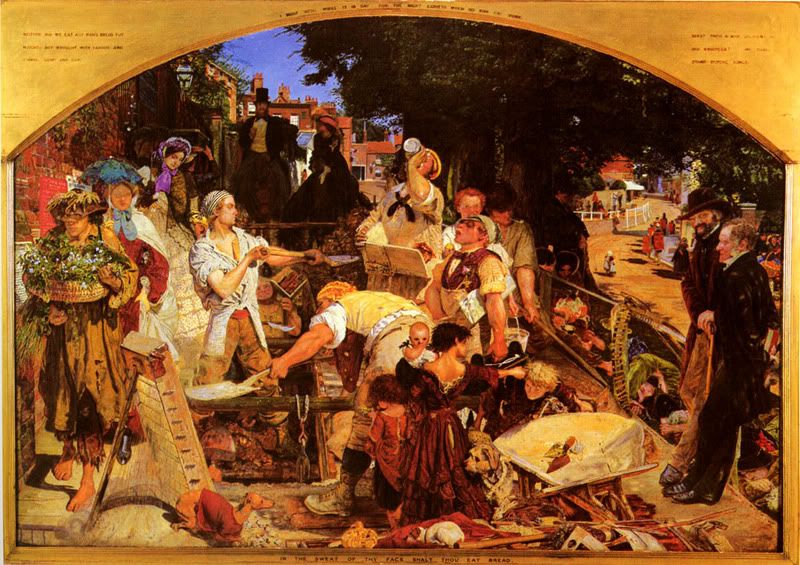
Ford Maddox Brown, "Work" (1865)


It is now more widely accepted that Derrida's philosophy was always deeply political, even if this was not an explicit theme of his writings at the earliest stages. The (non-)concept of différance, for instance, was a strategic intervention into the account of reason and its realization as existence designed to protect difference from those who might want to find some final solution by means of which differences could be resolved and thereby achieve some account of Truth. Différance, a Derridean neologism, is designed to play on the double meaning of differe, to differentiate and to defer, by creating the present participle. Différance is meant to refer to both meanings at once by invoking this participle form, and thereby indicate the fracturing that produces existence in all its differences through space and time.

Thus it is a quasi-transcendental description of the conditions of the possibility of difference. Without in any way suggesting that there was once a whole or Unity that is now being divided or differenced in some way, one must say that existence only is in this differentiated relationship, i.e, it is mediated. On the one hand there is differentiation, spacing, while on the other differences occur as deferral, temporality. Since one can only know something through its relationships in space and time, the object of knowledge is constantly being supplemented. Knowledge of the original, or more importantly to Derrida, of the Origin of meaning itself, is not possible, because it never arrives in fullness. There is always more to come. Thus instead of an origin, one finds 'originary difference': an instability at the heart of existence that constantly keeps things in motion and never allows one to rest. This is, in effect history. "If the word 'history' did not in and of itself convey the motif of a final repression of difference, one could say that only differences can be 'historical' from the outset and in each of their aspects."

This is by no means a neutral or apolitical description of (human) existence, but instead one that celebrates differences as free play and sees that play as hopeful for the future. To put it in other terms, the ontological description of difference is at the same time a call, by Derrida, for a kind of radical liberalization of the social order. The irreducibility of differences, including human inter-personal differences, means that, in the tradition of liberalism, there is a fundamental integrity to the individual that cannot be undermined. Invoking the rights tradition, he identifies a certain sovereignty that arises from the fact that every other is dependent upon every other such that no one can achieve domination. Thus Derrida himself understands deconstruction to be the continuation of a pursuit of emancipation, one of the great themes of the Enlightenment. Difference is ontologically rooted in such a way that no violence can hope to overcome it, suppress it and by no means could it be brought to an end.

Moreover this political theme is also linked to political economy when one remembers that another interpretation of the quasi-transcendental is 'originary exchange' in Specters of Marx. There Derrida argues against Marx that there is no use value and that commodification is an irreducible reality. Everything is subject to the judgment of the exchange relation. To paraphrase one of the very earliest Derridean statements, the implications of which were always the same: "There is no hors capitalisme". And so, in Derrida liberalism and capitalism are united into the whole they have always been in the Enlightenment tradition.

-LoA