Wednesday, February 28, 2007

the choice

Every nation, in every region, now has a decision to make. Either you are with us, or you are with the terrorists.
-George W. Bush, "Address to a Joint Session of Congress and the American People" (2001)


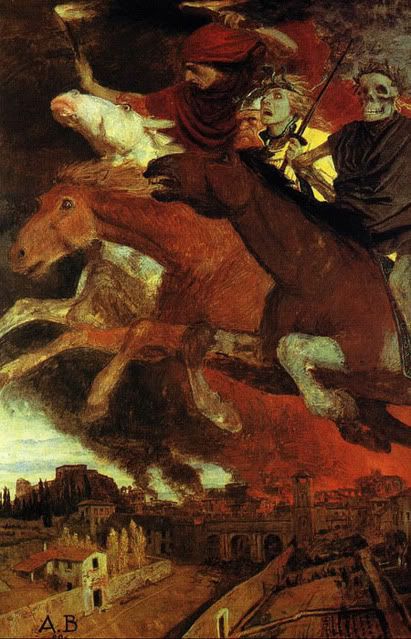
Arnold Böcklin, "War" (1896)


what do we choose?
in the war, along the fronts that divide us, where do we walk?
in the monumental battle between good and evil
where every other is the latter to the former,
where the forces of war call out to one another
along a front designed to maintain their animosity,
offering –
is it possibly true? –
an irrefuteable either/or
within which we must take a side,
should we not seek to walk within that fracture that divides,
the fracture that consumes declarations of war?
this is path on which the heathen rage,
along which traitors walk:
the nowhere
possessed by no one
that is the last hope of humanity.


-LoA

Saturday, February 24, 2007

night prayer (after reading christina rossetti)


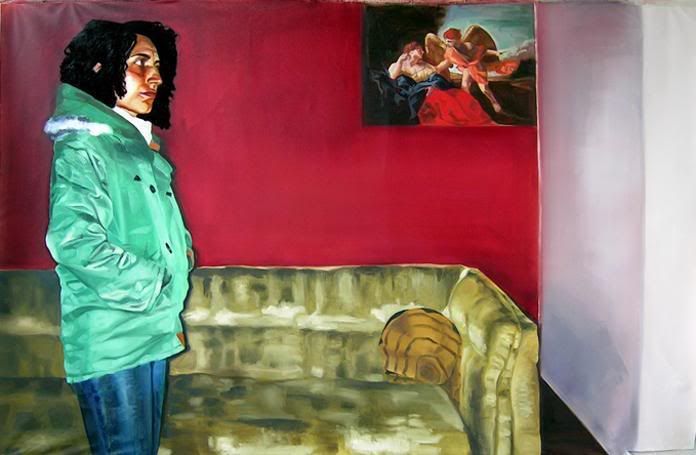
Sholem Krishtalka, "Hagar in the Wilderness" (2005)

That Sin would not hold me,
that Grace would drive my actions,
that Truth would would be my model,
Love my life and
You would call me Beloved,
I humbly ask,
Amen.

-LoA

Friday, February 23, 2007

the struggle, part 9 (guilt)

society is an ambiguous beast of which we find ourselves a member and which is, at the same time, something completely other. its failure to engulf me is what allows me to remain me in the face of its overwhelming enormity. i remain, beyond the vastness of a society which i cannot escape and which indeed makes my relations with others possible and meaningful. at the same time, i am never me alone; i am never the autonomous and free self i might wish to be. i am always a being-with-others. this being-with-others is the source of all conscience: con-science: thinking-with-others.

neither piety, nor love of neighbor can do justice to the complexity of these social relations. in love we attempt to seclude ourselves in the privacy of intimate relations so as to avoid the scope of our responsibility. it is true that love is blind: love is blind to those who are beyond the intimacy of the one with whom we have decided to identify and to whom we hold ourselves responsible. nor can we turn directly to god to absolve ourselves of the complexity of the social. the turn toward god, in the attempt to satisfy conscience, is to turn away from one's responsibilities, an attempt to shut out the voice of the many and reduce it to the voice of One that one claims will forgive all. but god is not blind.

we cannot live in such closed relations. and we know this well, unfortunately, no matter how we might try to hide from it. the guilt of conscience has to do with the fact that the meaning of who i am and what i do is not contained nor solely determined by my own intentions. my intentions lead me beyond what i intended into a relationship with the whole of society. in each of our intentions, our actions go out from us, always returning to us another way. they become detached from us and subject to the judgement of others. we become communal. we thus await the judgement of others: others we have never met, who appear as the face of strangers surrounding us in condemnation. beyond love, and all our claims to piety, there is the Whole which comes to us in many faces and whose voice is not one.

-LoA

Thursday, February 22, 2007

back in the desert again

hello to anyone still reading!

it has been a good month and a half since i posted and many things have happened including my annual bout of winter depression and anxiety: fun, fun. why am i so arrogant every year as to think, this year it will be different? if i can be permitted self-indulgent moping for a few moments -- and since i am probably the only one reading at this point, why not -- i reach that point where answering the phone becomes a serious challenge and is exhausting.

anyway, i came back from the holidays and completely crashed. this, combined with a move into a new home, and the beginning of a new semester of teaching, has made for no writing. hopefully this has now passed.

i have missed reading and interacting with so many of you. i hope you are well. i owe a special thanks to koonj and roohi hussain. koonj because she promoted this blog last year, and roohi, who read that promotion and put me in contact with people she knew. i am now in the process of writing an article on the art of iman maleki and alaleh alamir for the pakistani journal NUKTA. thank you very much. that opportunity has made me very happy.

best wishes to everyone, and i will be talking more here soon,
LoA.

Tuesday, February 20, 2007

the future of the left

The crisis began, perhaps, with Stalin. So many of the intellectuals of the Left found it necessary to take a side as Europe divided itself between east and west. Lukacs gambled on what he knew was an wretched regime if for no other reason than that it was the only regime with the possibility of resisting the hegemony of capitalism and its accompanying political liberalism. Horkheimer and Adorno set up shop to the west where they were free to critize both Stalin and liberalism, but for that reason lacked any sort of institutional support. The pogrom and the show trials only intesified the crisis for Left intellectuals and the optimism of Marxist political parties in western Europe dwindled. In the late 60s the giants of the Frankfurt School began to die off, Habermas defected over to the side of the liberals, while postmodernism, which turned out to be an apologetic movement for liberalism and capitalism, began to emerge as the direction of choice for "radical" thinkers. The fall of the Berlin Wall in 1989 was only the collapse of a rotting structure, the final gasp of a movement that had withered on the vine. We have reached a new situation in which, as Adorno had noted, the world has failed to achieve anything like a state of reconciliation, but also, contra Adorno, it seems the very rationality by which it might achieved has been lost, it seems obsolete.

This situation has created a vacuum which political liberalism would love to rush in and fill, but for which it will never be fully adequate even while it remains the one truly progressive force in existence at the moment. Humanity will never be content to ignore the question of the human good, which liberalism attempts to relegate to the private sphere under the guise of free speech, freedom of religion and the tradition of human and civil rights. With the collapse of the Soviet Union only the religions remained in a position to raise those questions to the political level, to the level where humanity finds itself bound together in a common project. Sadly, the horrible history of the 20th century has made progressives hesitant to propose such a universal project for humanity out of fear that this project will become corrupted and violent and deadly. Thus as human beings seek a sense of common direction, a sense of community that transcends the social and economic realm of private relations, the only place they had left to turn was to religious conservatives. The effects have been ugly and brutal: from the emergence of the Evangelical Right in the United States to Extremism in the name of Islam throughout the Muslim world to militant Hinduism in India.

Meanwhile liberalism itself seems to teeter on the brink of self-destruction. Having won the Cold War, survived the great Crisis of the Depression Era, and avoided the totalitarian pitfalls of fascism and Marxism, it stumbles about directionless: forgetful of its own dream of universal human dignity which is its great progressive legacy. European nations such as France and the Netherlands and even Britain, under the banner of liberalism, seem to be seeking a new form of fascism in the name of social "integration": how far, really, is Franofication and Dutch assimilationism from the legacy of Germanism and its rigid insistence on its own self-identification? In a different form, a similiar transformation seems to plague the States. The emphasis on freedom and "Democracy", on behalf of which the United States is willing to launch a violent Crusade for the salvation of humanity, has become mob rule. The rights tradition, the liberalism which once undergirded representative government, has become increasingly suspended, unimportant. The forgetfulness of the importance of that liberal tradition to a truly progressive government explains the seeming puzzlement of the Bush administration when democratic elections in the Middle East brought success for political parties of which the United States could never approve.

The cowardice of the Left, its inability to describe the historical moment in such a way that humanity could genuinely ask questions regarding the Future, is one of tradgedies of contemporary existence. While capitalism-liberalism lives in an eternal present without History, since its fundamental truths are timeless and ahistorical, buried and waiting to be discovered beneath the corruptions of tradition and (non-European) culture; and the religous zealots of the Right live in a dead past, clinging to an understanding of revelation that is over and done with and can only be repeated again and again; only those who are able to ask the question concerning the Future can genuinely offer humanity any hope. Only those who understand human existence as a communal pilgrimage for Truth which is not yet fully known can possibly move forward towards it, those who see History as the history of revelation and as a quest for salvation. Only if there is a Future can the New emerge.

Sunday, January 7, 2007

tragedy; or, two sides of the road


LoA, "The North-Side of the Road #1: 1 of 4" (Christmas 2006)

tragedy does not refer to just any old sad event, nor it is a term to be used to describe catastrophes without some further qualification. according to hegel at least, tragedy is a technical term that is used to describe the inevitable moment in which a conflict arises between two relative goods. perhaps his most famous example, and certainly one of the triumphs of hegelian literary interpretation, is the play Antigone, with its conflict between antigone and creon over the burial of their brother. the brother participates in an attack against their city and is killed. he lies dead in the field beyond the city walls. creon, the ruler of the city, declares that anyone who goes out to bury the dead will themselves be put to death. but antigone does sneak out and bury their brother. creon follows through and puts her to death by enclosing her in a cave.

this play is the height of tragedy for hegel and represents one of the most fundamental conflicts: the conflict between family and city. this the tension that arises between one's family or the ties of blood, especially symbolized by the female for hegel, and political, which is an expression of one's free rationality. but just because each is a relative good does not mean there is not an order to preference in hegel. the family is, in the tradition of roman law, the foundation of the state in hegel, but it only becomes a solid foundation for the state by being transcended, and seen in its relativity. in other words, the political is the consummation of familial ties. it translates natural family bonds into rationally formed free relations between persons -whether blood relations and not. without the family the state cannot be, but if the family is taken as an end in itself it will disrupt the functioning of human freedom in the political sphere by fragmenting the human community. it is a good that must be defended (antigone), and it is a danger that must be overcome in favor of what is higher (creon).


LoA, "The Sound-Side of the Road #1: 2 of 4" (Christmas 2006)


today antigone lives to the East'ard and in a manner that would be considered low drama to most people, tragedy is slowly unfolding again. how else can one explain the actions of the native residents of the island than through recourse to the very insightful hegelian category of tragedy. in novemeber of 2006 a ballot initiative was put before the full time residents of the East'ard: ought the island incorporate into a town with a local government or should it remain an unincorporated area. the idea of incorporation and the formation of a local government was roundly defeated.

the initiative came to the ballot in the wake of certain real estate developments that had taken place over the course of the last couple years. on the west end of the small island, just as one comes over the bridge that links the East'ard to the West'ard a fairly substantial housing project had been undertaken, and while a few locals bought homes there, the prices were such that the project was clearly aimed at wealthier outsiders who were looking for either retirement homes, or summer beach homes. the homes were beautiful but beyond the reach of most native residents. then, in the summer of last year, a small home, more towards the eastern end sold. it sat on a moderate sized piece of property and the home itself was hardly remarkable: brick, old construction, in need of some moderate repair. there was nothing remarkable about the home other than its view of the water. it was the type of home that residents of the island, with a small family, could eventually hope of having for themselves. until that day, when the home sold for approximately 1 million dollars. this radically changed the landscape of the East'ard, and as i travelled around the island over new years it became clear that the island was for sale. long time residents were cashing in.

and so the ballot initiative: would the people of the East'ard incorporate and take control of the now inevitable development their long time home, or would they refuse to incorporate and allow it develop in a manner completely beyond their control. while it may seem counter-intuitive, it is not surprising that they refused to incorporate, and indeed was rather easily predictable. government is not looked upon with any sympathy by locals, as they have fought long battles with the foreigners of government who try to regulate their fishing: what can they catch, when can they catch it, how can they catch. the government comes along and interrupts their livelihood and the long traditions of fishing that they have practiced for generations. why would they want to invite 'government' to come and set up shop right on their very island, to come along and tell them how to live their lives. they have always handled their lives just fine themselves through the long-standing ties of familial relations that bind all the residents together by nature.


LoA, "The Sound-Side of the Road #2: 3 of 4" (Christmas 2006)

by nature and not by freedom. they failed to make the decision to transform, to consummate these unchosen and given relationships, into some freely chosen and political, and so they have agreed to the death sentence that is inevitably going to follow on their way of life. their life is being purchased from around them and soon they will no longer be at home in their own home. nature will be disrupted by something other. one of two things is bound to occur. north carolina has a very liberal law governing city expansion. it is for the most part a good law as it has kept urban decay to a minimum in nc. according to the law, cities can, of their own volition, and without the consent of party being annexed, include outlying, unincorporated land within their city boundaries if they provide certain basic city services to that area. so either, the Town, which lies a short distance across the water, will see the rising property values and decide to incorporate the East'ard in order to gain the revenues of those tax values and the natives will be unable to stay to due the sudden and dramatic addition of city property taxes, or the newcomers who are moving the East'ard, the so-called ditdotters and dingbatters, will, once they represent the controlling majority on the island, incorporate the East'ard to prevent its incorporation by the Town. meanwhile the natives can exert no control on the manner in which their island is developed or what is built there because there are no zoning regulations of any kind in what 'the government' views as essentially free territory. large homes are being built, on the water of course, immediately across the road from trailer parks. there is talk of condos being put in at one end of the island.


LoA, "The North-Side of the Road #2: 4 of 4" (Christmas 2006)


antigone is once again being shut in her cave, of her own choosing, to die. and no matter how she curses creon, her unshakeable belief in the ultimacy of the natural ties of family, against that autonomy which involves rational-freedom, political freedom, brings upon her her own condemnation.

-LoA

Friday, January 5, 2007

the silent voice of bath-sheba

And it came to pass in an eveningtide, that David arose from off his bed, and walked upon the roof of the king's house: and from the roof he saw a woman washing herself; and the woman was very beautiful to look upon. And David sent and enquired after the woman. And one said, Is not this Bathsheba, the daughter of Eliam, the wife of Uriah the Hittite? And David sent messengers, and took her; and she came in unto him, and he lay with her; for she was purified from her uncleanness: and she returned unto her house. And the woman conceived, and sent and told David, and said, "I am with child." And David sent to Joab, saying, Send me Uriah the Hittite. And Joab sent Uriah to David. And when Uriah was come unto him, David demanded of him how Joab did, and how the people did, and how the war prospered. And David said to Uriah, Go down to thy house, and wash thy feet. And Uriah departed out of the king's house, and there followed him a mess of meat from the king. But Uriah slept at the door of the king's house with all the servants of his lord, and went not down to his house. And when they had told David, saying, Uriah went not down unto his house, David said unto Uriah, Camest thou not from thy journey? why then didst thou not go down unto thine house? And Uriah said unto David, The ark, and Israel, and Judah, abide in tents; and my lord Joab, and the servants of my lord, are encamped in the open fields; shall I then go into mine house, to eat and to drink, and to lie with my wife? as thou livest, and as thy soul liveth, I will not do this thing. And David said to Uriah, Stay here today also, and tomorrow I will let you depart. So Uriah stayed in Jerusalem that day, and the morrow. And when David had called him, he did eat and drink with him; and David made him drunk: and at even he went out to lie on his bed with the servants of his lord, but went not down to his house. And it came to pass in the morning, that David wrote a letter to Joab, and sent it by the hand of Uriah. And he wrote in the letter, saying, Put Uriah in the forefront of the hottest battle, and withdraw from him, that he may be smitten, and die. And it came to pass, when Joab observed the city, that he assigned Uriah unto a place where he knew that valiant men were. And the men of the city went out, and fought with Joab: and there fell some of the people of the servants of David; and Uriah the Hittite died also. Then Joab sent and told David all the things concerning the war; And instructed the messenger, saying, When you have made an end of telling the matters of the war unto the king, if the king's wrath arise, and he says unto you, Why did the army approach so near unto the city when we did fight? doesn't everyone know that they would shoot from the wall? Who smote Abimelech the son of Jerubbusheth? did not a woman cast a piece of a millstone upon him from the wall, that he died in Thebez? why went the army nigh the wall? then say you, Thy servant Uriah the Hittite is dead also. So the messenger went, and came and shewed David all that Joab had sent him for. And the messenger said unto David, Surely the men prevailed against us, and came out unto us into the field, and we were upon them even unto the entering of the gate. And the shooters shot from off the wall upon thy servants; and some of the king's servants be dead, and thy servant Uriah the Hittite is dead also. Then David said unto the messenger, Thus shall you say unto Joab, Let not this thing displease you, for the sword devoureth one as well as another: make thy battle more strong against the city, and overthrow it: and encourage him. And when the wife of Uriah heard that Uriah her husband was dead, she mourned for her husband. And when the mourning was past, David sent and fetched her to his house, and she became his wife, and bore him a son.

II Samuel 11.2-27 (original court history, c. 961 B.C.)


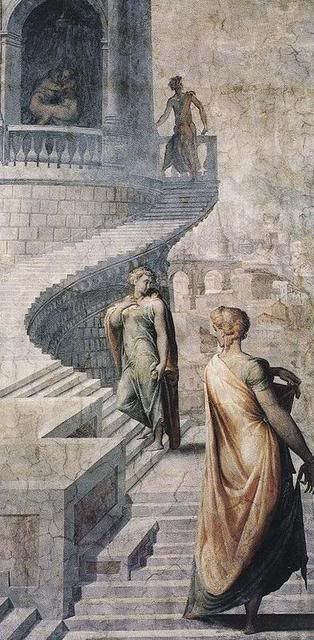
Cecchino del Salviati, "Bathsheba Goes to King David" (1554)


One wonders what Bath-sheba thought when the king stared shamelessly into her bath. What did she think when he requested her presence at his palace. Did she resign herself; did she protest; did she seize upon it as an opportunity; did she embrace him with passion, alive in the rush of heat and power. What must she have thought of him when he sent her away the next morning. How did she tell him she was pregnant. What did she fear (or was it hope) would happen; a plea for her life to the man who had put it in danger to satisfy himself, even though he could have had any woman, and had many to choose from within his own house. Was that pride or pleasure or shame which she carried in her heart. What did she feel when the king had her husband murdered, along with so many others. When he married her. Did she laugh or weep in private. When she lost her child. Did she rejoice in the political instability that followed his sudden marriage to this pregnant wife of a foreigner, or regret it for his sake. For the sake of her future. How she must have smiled to the king's face in order to promote her son, Solomon, to protect him against the king's other children. And when the king died, with another young woman in his bed, what did she feel.

We will not know, because no one bothered to ask her.

But let us not take this silence as a final word. Even in silence she speaks. Hegel taught us that every attempt to enforce a boundary is an admission of defeat because it secretly recognizes that the boundary it builds can be crossed. If it could not be crossed, there would be no point in defending it. The enforced silence of Bath-sheba is broken at the very point where her silence is inscribed by historians. At precisely that moment Bath-sheba screams with a voice that demands to be heard, insists on her own legitimacy and ends, upon her own humanity. Insists that she is more than the wife of Uriah, more than the king's legitimized whore, and more than the mother of a king. Her silence speaks of the inability of the official history to silence Bath-sheba for she also is a member of the Whole. It reveals the weakness of those who thought they owned her, used her, traded her and conquered her. Her voice echoes as loudly now as it did through the halls of a king's palace. Only, we can no longer pretend we do not hear her.

-LoA

Wednesday, January 3, 2007

east of the east'ard

let us call the island "the East'ard": as the natives say, i'ma headed to the East'ard. it was the place i was born and the home of my mothers half of the family to this day. it is the site of my granny's home and the place i spent new years with my family. the East'ard is a small island: 5mi long and 3mi wide at the widest point, much narrower than that for the most part. the folks who have lived to the East'ard for the bulk of their lives are fishermen and dredgers, married to women who have raised large families and can dip snuff and spit t'bacca as well as any man and better than most. they are what one would call the salt of the earth, and indeed you spend much time on the East'ard and you will be a bit salty yourself. the East'ard is not the end of the earth, but it is your last stop before you arrive there. many of those who live on the East'ard have relatives on the Banks, especially on Ocra'co. in the not so distant past mail travelled from the East'ard to the Banks and back by means of the coast guard who maintained a post at the end of the East'ard, known as Shell Point, and on Cape Lookout at the Lighthouse. my mother remembers her grandfather running the mail back and forth on his boat.

Cape Lookout is no longer a coast guard station and the last of the homes over on the Cape were closed a few years back. but the light still runs...and it can be seen from most anywhere to the East'ard. i offer the view from Shell Point: Cape Lookout Lighthouse lies 4mi east of the East'ard.


LoA, "Cape Lookout Lighthouse from Shell Point" (Christmas 2006)

best wishes to y'all, and real posts to follow tomorrow.
good night.
LoA.

Tuesday, January 2, 2007

my first home

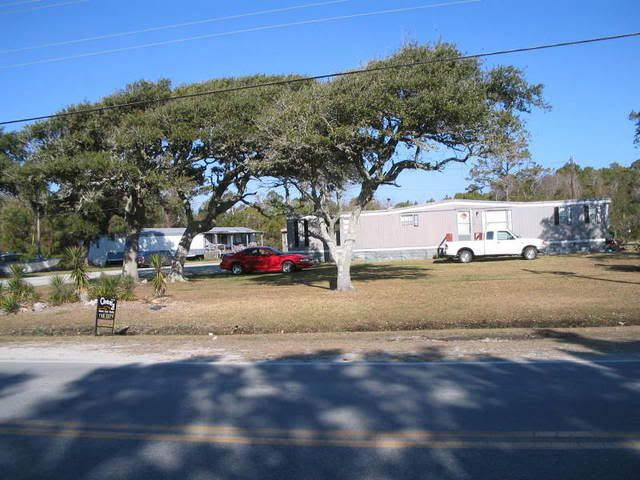
there are many pictures and posts about life on the Island that will follow once we get back from our christmas forray (as early as tomorrow). today i share a simple picture of the first place i lived. this was the lot where my parents trailer sat when i was born...many years ago.


LoA, "Baby-LoA's First Home" (2007)

best wishes and happy new year to you all,
LoA.

Monday, January 1, 2007

christmas cheer

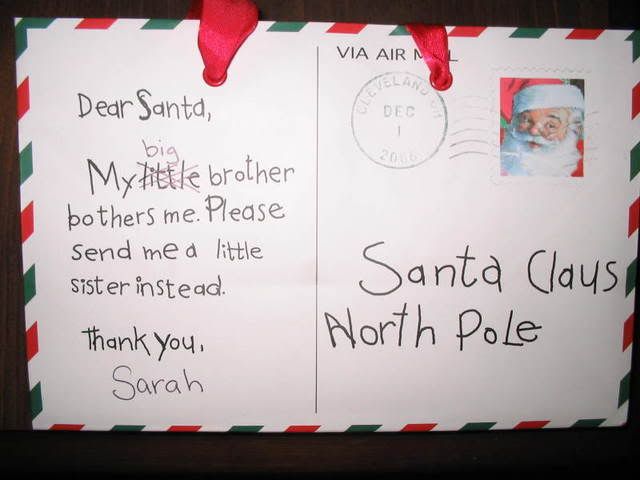
my sister clarifies her feelings...


Christmas Bag, (Christmas 2006)

Saturday, December 30, 2006

eid mubarak

asalaamu aleikum,

may god bless and keep y'all, and may all our wills increasingly conform to god's own.

eid mubarak,
LoA and She.

Friday, December 29, 2006

the promise of victory (a draft)


Franz Stuck, "Lucifer" (1890)


we sat amid the ruins of the new jerusalem
at the dawn of the end of the day

as the fires smoldered amid the walls
and the soldiers put on a parade

there was dancing and singing
and the leaders were there
there were horses and canons and songs
there were trumpets blaring
to drown out the noise
of the sacrifice of innocents below

in the valley of gehenna
the children were dying
and the soldiers put on a parade
marching each one
to Moloch's brash song
and to the pounding drums of rage

the war god was living
and the people were singing
and band played all through the night
his priests smiled sweetly
and promised us victories
and in the flow of blood took delight

and while death embraced us
and the people made love
to hate by the ocean that night
the screams of the children
came up from gehenna
to the ears of old Moloch

we sat amid the ruins of the new jerusalem
that city that sits on the hill

as the lights went out one last time
and Moloch walked smugly away

-LoA

let there be blood

we wait for the death of one more person in iraq. cnn promises it is imminent. he is at the site of his execution. certainly he will not be the only one to die there today: not the only person killed even. probably not even the only one executed, as executions in various forms seem to have become a common place, especially in baghdad. no one seems to be content until the blood runs to the bridles. so by all means, let there be blood.

-LoA.

Thursday, December 28, 2006

north carolina: its about the tobacco, stupid!

for those of you looking for something a little less likely to put you to sleep than an account of poverty in a 1st century christian author, i offer the following...

let us call the year 1980: it is a nice round number and my memory is not so good when it comes to years. my life is divided by events: before saudi, saudi, after saudi, college, masters, ph.d, now. this falls in the years just before saudi.

we referred to my maternal grandmother as 'granny'. now my granny was quite the character, and indeed i should start a new segment called "granny stories" just for nancy, because i know she loves them so much (yes, that's right, i know you are out there, even if you are just lurking). anyway, one saturday afternoon, granny drives into town (where my family is from, 'town' is anywhere with a stop light, but generally refers to the western half of the county) to go shopping at piggly wiggly (a grocery store) and eckards (a drug store). upon arriving she promptly proceeds to lock her purse in the car. so, she finds a pay phone (what did we do before cell phones?) and calls my father to come and help her.

the drive into 'town' is about 15minutes from where my parents have their house (about 25 mintues from granny's house, for those who are trying to draw a map), and my father was working in the backyard. so let's say he took 7 minutes to clean up a little, and get the things he needed to get her car unlocked and then add the 15minutes to drive into town. this adds up to a grand total of 22minutes. so let us say my father arrives at granny's location 22minutes after she calls. he arrives to find her standing by the car, the driver's side window broken in. granny has thrown a brick through the driver's side window so that she could get into her car. "why?" you might ask, has she done such a thing. it would be a very natural thing for you to ask, and not surprisingly my father also asked this question. granny's answer: "my ciggies were in my purse."

just by the way, in the way of a post-script...granny called the police to report that someone had vandalized her car!

-LoA.

poverty and power in luke

The Gospel of Poverty

When one pays close attention to Jesus, as presented in Luke, one finds an interest and emphasis on the issue of poverty. Luke is well aware that in the everyday of functions of life, privilege and deference are usually extended to those with money, while those who are outcasts and those who are poor are ignored, discriminated against and often despised. But there are many scenes from Luke's Gospel, many of them unique to Luke, which demonstrate his belief that the coming of the Kingdom of God reverses this ordering of existence, and that Jesus embodies this reordering.


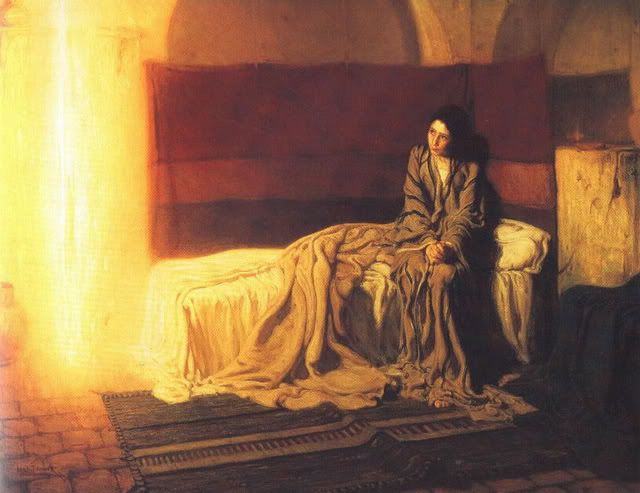
Henry Ossawa Tanner, "The Annuciation" (1898)


The Birth Narrative

There are two important incidents relative to the theme of poverty in the opening chapters of Luke. Having begun with the birth of John the Baptist and the announcement of that miraculous birth to John's father, Zachariah, Luke moves on to the birth of Jesus. While in the Matthew's account of the birth of Jesus the focus is largely on Mary's prospective husband, Joseph, and his indecision concerning what to do about the pregnancy of his bride (especially since he is not the father), Luke focuses instead on Mary. The angel Gabriel, who had already appeared to Zachariah (1.19), now appears to Mary to announce the miraculous birth of her son, who will be conceived without sexual intercourse (1.34-35).

Mary replies in the form of a hymn that echoes the song of Hannah (I Sam. 2.1-10). Hannah had been barren, and having prayed to God to grant her this blessing, she was granted a child which she dedicated to the service of God in gratitude for his birth. Now Mary also has a child who will do the will of God. Mary declares that the child will be a demonstration of divine strength. The proud are to be humbled, the powerful are deposed from their thrones, and the rich are stripped of their goods. God will then promote the lowest to prominence and assure that the hungry are fed (1.52-53).

But there is another more interesting and telling contrast between Matthew and Luke. In Matthew's account of the birth of Jesus, it is the rich and powerful from far off places that come to visit Jesus and celebrate his birth. The magi travel a great distance, and are of such standing that they are allowed to visit the political ruler of the land. Upon finding Jesus they give him very expensive gifts (Mt 2.1-12). By contrast, Luke has angels come and announce the birth of Jesus to shepherds sitting in the dark with their flocks. They do not bring gifts. Instead of being the one who receives gifts, Jesus is the gift that has been given to them. These poor, those who have nothing, are the ones on whom God has looked with favor (2.8-20).

What one finds in these two examples is that Luke is already using the birth narrative to argue that God's power and strength are not comparable to the royalty and power of this world. God's power and strength favors those who are powerless and poor. It is not something that attracts the wealthy, but overturns their tyranny.


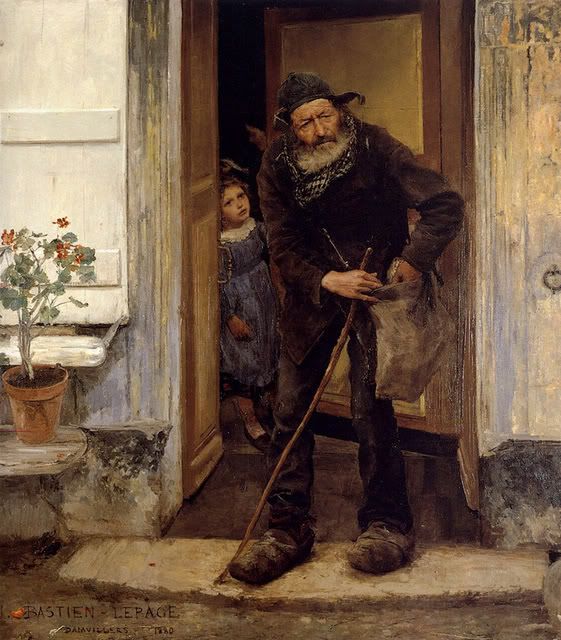
Jules Bastien-LePage, "The Beggar" (1880)


Sermon on the Plain (and the Sermon on the Mount)

One of the most famous parts of the message of Jesus, as it is found in Luke, is what is commonly known as the Sermon on the Plain. The sermon is memorable if for no other reason than the repetitive cadence with which it is delivered. Over and over Jesus tells us "Blessed are..." and then goes on to list the blessed, those on whom God has looked with favor. Luke likewise follows this up with a series of "Woe to...", listing those who stand in opposition to the coming Kingdom of God. Luke's list is straightforward. God has come to bring the Kingdom to those who are poor, those who are hungry, and those who suffer and are hated (6.20-23). The Kingdom though stands in judgment against the fat, rich and decadent rulers of this age, since they have profited and taken delight at the expense of others, and they will be overthrown (6.24-26).


This is a remarkable enough example of Luke's privileging of the poor and reversal of standard conceptions of power, but it becomes even more striking when one contrasts Luke's account with that of Matthew. First of all, there is the setting. Matthew literally places Jesus in a position of height, overlooking his audience, and so, in Matthew, this comparable event in the life of Jesus is called the Sermon on the Mount. Luke places Jesus in a flat place which de-emphasizes the authority and power which is the focus of Matthew's geographic setting. Then, when one turns to the content of Matthew's Sermon on the Mount one quickly notices that it altogether lacks the curses (or "Woes") found in Luke's depiction of Jesus' sermon. The denigration of earthly power that is central to Luke is not to be found in Matthew's account. But while that absence is important, the alternative wordings that Matthew chooses for the blessings clearly show the power of what Luke has chosen to emphasize. Matthew, in two spots where he clearly overlaps with Luke, the blessing of the poor and the blessing of the hungry, chooses to spiritualize that blessing. For Matthew those who are blessed are "poor in spirit" (Mt 5.3) and those who "hunger and thirst for righteousness" (Mt 5.6). In Luke there is no such relativization of the blessing. It is those who are poor and starving that God has come to deliver, and who will be the graced and chosen in the new Kingdom.


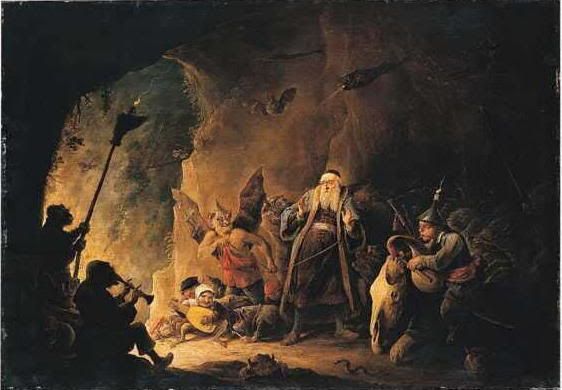
David Teniers the Younger, "The Rich Man Being Led to Hell" (c.1647)


The Problem of Wealth

While Matthew does, in a limited way, suggest that wealth is an impediment in another place (Mt 19.24, a passage shared with Luke (18.25) and Mark (10.25)), what we find lacking in Matthew that is constantly present in Luke is the placement of this idea of the overturning of the relations of wealth and poverty at the very center of the message of Jesus. What is clear is that wealth ties a person to a set of conditions that are positively detrimental to their salvation. This is seen in two stories that are unique to the Gospel of Luke.

First there is the story of the one who prospers. As he prospers he begins to be concerned with how to store and protect his increasingly abundant goods. He builds barns, and new buildings, and makes plans to enjoy the good life. But, says Luke, such a person, in the process of becoming wealthy has become poor and disgusting in the eyes of God. Wealth is not an insurance that can guarantee the soul, nor can it purchase eternal happiness. When one is dead, one's wealth is lost and so one person who spends their life building and caring for their goods is truly impoverished for they have nothing of real value (12.13-21). Indeed, they are dead already.

But what is clear, from the second story is that this is not simply a subjective problem, a problem of the soul. Wealth exists at the expense of those without, and by its very existence treats with distain the poor that God has chosen as God's own. Thus one finds in the story of Lazarus and the rich man that the poor and sick Lazarus lies in the streets without respite, while the Wealthy lives in sumptuous luxury. But the earthly appearances are deceiving, and it is ultimately the poor and meaningless Lazarus who finds himself in Paradise, while the powerful are condemned and suffer (16.19-31). As Abraham's words to the Wealthy makes clear, the fault against the Wealthy is not subjective, but the objective fact of his wealth which itself created his own damnation; he is guilty of nothing other than being the Wealthy. In each case, in the coming Kingdom of God, wealth and power are overturned in favor of the powerless, poor and hungry.


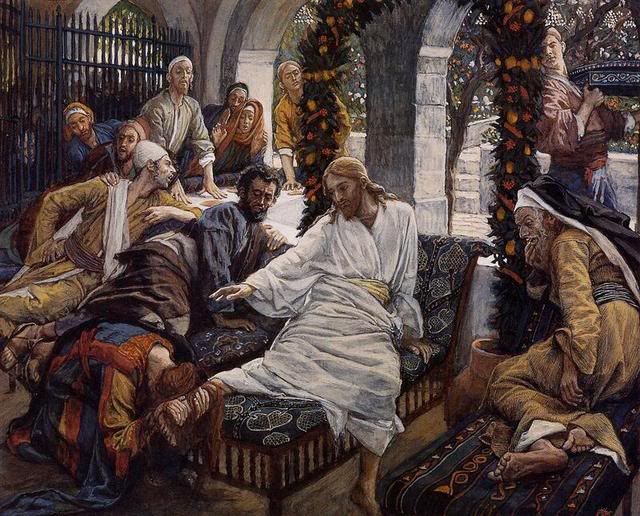
James Jacques Joseph Tissot, "Mary Magdalene's Box of Very Precious Ointment" (1902)


The Good Samaritan

In the end it is the outcast who knows and understands the sympathy, compassion and care that are the hallmarks of real divine power. Having suffered under oppression and having been despised, they are not offended by the suffering of others. And so, when, in the parable of the Good Samaritan, a man is waylaid, beaten, robbed and left for dead, the ones who are symbols of holiness and religious power, those associated with the Temple, avoid him, crossing to the other side of the road so as not to have to be near him (10.31-32). But then a Samaritan comes along. The Samaritans were marginal members of Jewish society, because they did not participate in the Temple cult, and did not view Jerusalem as holy. But this outcast is the one who demonstrates the compassion of God. He rescues the stranger and pays for his treatment (10.33-36). Once again we find Luke stressing the way in which it is actually the powerless which prefigure the Kingdom of God.


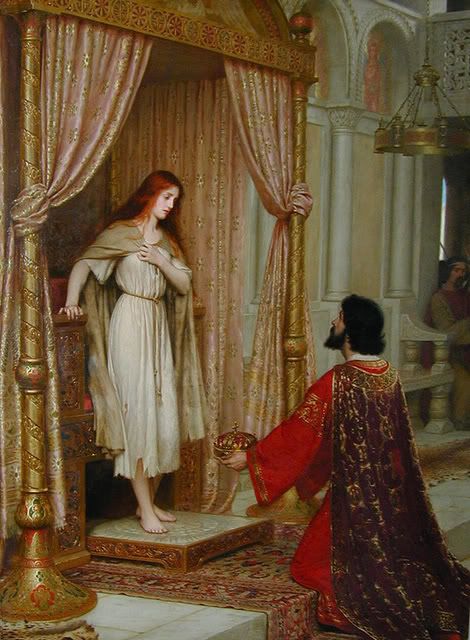
Edward Blair Leighton, "The King and the Beggar Maid" (1898)


Conclusion

Indeed, the wealthy and powerful were by Luke's estimation, both objectively disordered and subjectively deaf to the message of repentance and had no interest in a real coming of the Kingdom of God. The rich man had been given ample opportunity, Luke warns, even miracles would not change the mind of him or those like him (16.27-31). This is why Jesus was sent to the dregs of society, to those who could hear a message of hope. As the religious leaders of the day complained, Jesus ate with prostitutes and tax collectors, stayed in their homes, treated them as neighbors. For Luke it is not the poor who are thieves, but those who profit off of others in supposedly legitimate ways and go home with a clean conscience at night. This is why Luke threatens society with the great reversal. The last will be first, and in the end the first will be last, because it is those who are society's last, those who are not enmeshed in this world, who are closest to God.


-LoA

Tuesday, December 26, 2006

god is not rich

i hate those people that tell you
money is the root of all that kills
they have never been poor
they have never known the joy of a welfare christmas

everclear, "i will buy you a new life," so much for the afterglow (1997)


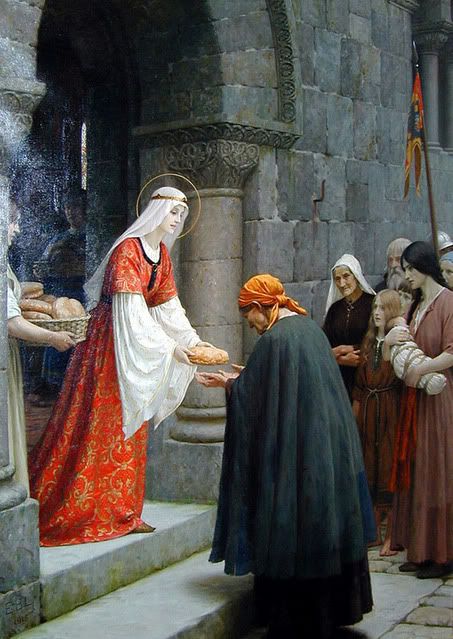
Edward Blair Leighton, "The Charity of St.Elizabeth of Hungary" (c.1900)

i spent the better part of this past semester arguing to my students that francis may have been crazy, but if he was it was the good kind of crazy. i argued that francis needed to be interpreted not merely economically and politically, though this was important, but as a mystic, in the tradition of pseudo-dionysius and meister eckhart; that there was little distance between bonaventure's theory and francis's praxis.

partly i made this argument for my own benefit. i have always struggled a bit with the franciscan tradition and the belief that poverty was a good. in the 21st century the distance between the medieval mendicant orders looks small, but the franciscans really were radical in a way that, for instance, their nearest contemporaries, the dominicans, were not. for dominic, poverty was pragmatic. wealth symbolized corruption, decadence and heartlessness to those dominic was trying to reach. thus dominic insisted that the order lay aside wealth in order to reach those persons. francis on the other hand embraced poverty as a good.

i grew up in a home that was poor. the poor child of parents who were pulling their own way out of even greater poverty. my father spent most of his childhood in a small two room house that i only knew as a shed, leaning precariously to one side, used to store my great-uncle's lawn mower and a few other gardening items. it fell down a few years ago when a hurracaine blew it over. my parents were both the first in their families to get college educations. my father did not finish his until well after i was born. my mother, who was, in her youth, a better student, never used her teaching degree to earn money until after my little sister left home when i was in my 20s. i came along and interrupted her plans of being an elementary school educator.

we lived in a trailer in the middle of a large trailer park: the north carolina sun beating down and baking my mother in summers so that she would flee, me in tow, to the shopping mall or grocery store in order to find air conditioning. my first christmas was a green-stamp christmas. i have vague memories of our already outdated black and white television being broken for several years because they could not afford to fix it. there was a small (and later larger) garden through-out my childhood, not because my parents had any particular interest in gardening, but because it meant they did not have to buy so many vegetables. i could go on...

the truth is, i was so young i did not realize we were poor and by the time i was old enough to be able to comprehend it my father had completed his engineering degree and was working full time and we were not poor any longer. nonetheless it gradually became clear to me that we had been poor and that this was not the poverty of francis. this poverty hung about the necks of my parents like a millstone and they needed, desparately, to get out from under it. the poverty of francis was meant to be freeing, and freedom lived in pursuit of god. the goal was to create a situation in which one no longer desired anything other than god. and so, just as the great mystics would strip away every concept that stood between them and god, so also, francis insisted on stripping away every physical reality. it was a struggle to master not only the mind, but the desires of the body as well: to recover the beautiful edenic life, where body responded to mind, and reason and the will governed the material order.

it is a truism of medieval theology that god does not need anything. god is the Whole, full and complete. and if one is to be engodded, if is to be an alter-Christus, as francis's companions identified him, one must also desire nothing. this could only happen when one let-go and could simply be. god does not have nor possess, nothing belongs to god as a piece of property, god is the One that is also All, with nothing to lose or gain. for francis poverty was the way of capturing that idea, a way of reaching the point where one could simply identify in one's being and will with the divine in perfect love.

i am not poor; indeed i am, when looking at the world in its entirety - though this perspective is lost if one lives in america too long - one of the rich, one of the aristocrats, so fascinated by francis. i am elizabeth of hungary, looking for some way to lay aside my crown. having been spared the poverty of my family's background, i am now unable to find the poverty of francis and am instead trapped within the poverty of riches. i still have my theoretical issues with "voluntary poverty", but where will one find an alter-francis, in any case, that could show one the way?

-LoA

on the possibility of the gift

...forgiveness and gift have perhaps this in common, that they never present themselves as such to what is commonly called experience, a presentation to consciousness or to existence...
-Jacques Derrida, "To Forgive" (1999)


Ad Reinhardt, Untitled (c.1958)

without box: cardboard, color of sturdy brown, corners sharp and well defined to provide compartmentalization and precise dimension, a place well-suited and well-confined

without paper to annouce the gaeity that must be attendent with the ripping and tearing excitement, but also declaring the limits thereof with the passing of the paper into disposibility: laughter only in its time, joy in due season

and ribbons - certainly not ribbons and lace - that tight bond of frilly, faux fraternity that is only an affect: to be untied and thus undone

but because without

i lie in bed wondering if anything has transpired at all, having long elaborate conversations of light against lattice and the silence of wind staring at the window.

-LoA


Sunday, December 24, 2006

standing outside the mosque at lahore: appendix


Yunsheng Huang, Untitled (the front facade of the Wazir Khan Mosque in Lahore) (2001)


see "
standing outside the mosque at lahore: the modesty of edwin weeks"

Thursday, December 21, 2006

hajj (1982/1403)

And proclaim that the people shall observe Hajj. They will come
to you walking or riding on various exhausted (means of transportation). They
will come from the farthest locations. (22:27-28)


Johan Berthold Jongkind, "Leaving the Port of Honfleur" (1865)


my very first flight left from a small airport in new bern in the rain. i hobbled around the lobby waiting to board, a crutch under each arm because less than a week before i had twisted my left ankle so badly that the muscle tear had literally pulled bone away from the side of my foot. but they were nothing but an annoyance to me now; i felt no pain, only that they were slowing things down.

when we finally boarded i was excited about flying in a way that i have since more than recovered from. the plane pushed its way up into the gray sky and bounced its way along towards dc. my mother's face was the same color as the sky long before we got there.

by the time we arrived in nyc i decided it was time to dump the crutches. the foot never healed correctly and it still hurts for me to sit cross-legged if my left foot is on the bottom, but even now i dont regret it. i walked on two feet onto what is still the largest plane i have ever been on. the pan am double-decker had sleeping quarters on the upper floor for those who had the money. but the government was only paying for our family to fly third class.


Jean-Léon Gérôme, "Arabs Crossing the Desert" (1870)

it is not only the largest plane i have ever been on, it may well be one of the most crowded flights i have ever been on. i have been on other full flights since, all of which were much less enjoyable, but this flight teemed with life. there was an energy i could not have understood at the time which made the plane seem about to burst. and that energy lasted for almost every minute of the fifteen hour, non-stop flight.

it was almost as if we had booked a flight on a family reunion. people, most of whom had never met before that flight, chatted joyously like old friends, relatives departed and only now reunited. i dont remember when the singing started. somewhere over the atlantic, in a language i could not understand, people, drunk on nothing but happiness, joined together in one voice. in and out of a dramamine induced sleep, stretched across the lap of a total stranger, the festivities went on around me. this was flying, and flying was a party.

we were over land and the party went in an uneven ebb and flow when a transformation began to take place. a slow stream of people male and female began to move to the bathrooms, still three or four hours from our destination. they began to undress themselves of america and become something else. fantastic clothing, a sea of flowing white, but new to me, unseen before and thus fabulous, like butterflies. and as the transformation took hold among the passengers, leaving only us as defective, stunted human beings trapped in our cocoons, the party in the sky reached its climax until someone, in the now-foreign language that was english, announced that we were descending.


Jean-Léon Gérôme, "An Arab Caravan" (c.1870)


it was a descent into light, and overwhelming brightness. as we approached the ground i stared out the window: a small herd of camels trotted underneath us, glancing casually upwards. the plane slammed downward onto the runway, as if we could not land fast enough now. the shutters banged down and everyone let out a collective gasp, and then applause.

the plane parked not far from the terminal and a ramp was brought alongside. and we advanced slowly upon the exit. i was a child of the south, raised on heat and humidity in equal portion with eggs and grits. but when i stepped off that plane, nearly blinded by the purity of the light, i was embraced by the new world, wrapped in warmth and moisture that tangibly took hold of me. and i was in dhahran.


-LoA


the virtue of being broken (a brief reflection on heidegger's being and time, §16)


Evelyn deMorgan, "Cassandra" (1898)


in moments of harmony and peace, we are actually quite blind to the Real. there is nothing that would disrupt our efforts and our immersion in the habits and traditions of the culturally inherited world by which we are. precisely because reality is harmonious, one is led even deeper into harmony itself, lost in its seeming obviousness and inevitability. everything we are is given in that harmony and nothing seems external or limited by the Real which benevolently shelters us from the need for thought or introspection.

knowledge arises precisely as things break down, in dischord and disharmony. at the point where one becomes disjointed and pulled out of the comfort of oblivious obviousness. suddenly the world appears in its objectivity; the world appears as something fashioned and made and thus susceptible to fracture. after the appearance of the first false note, even if the harmony is regained it can never again be the same, since now even the harmony itself is revealed to be an artifact: something crafted by human pursuits and practices. harmony and disharmony become thematic concerns for the self as one struggles to make sense. and the natural-harmony shows itself false insofar as it blinded its inhabitants to their rational and free natures.

this is why the prophet can never have a home, because the prophet is the one who stands in the moment of freedom and reveals the naturalness of the harmony, upon which They so strongly insist, to be nothing more than the blindness of animal instinct and barbarism. even harmony, insists the prophet, must be made one's own in a moment of lucid rationality that sees through to the Truth-in-which-humanity-itself-is-a-participant: a moment that will transform oneself and the Real to its core. broken, the prophet will be hated by those who think themselves healthy; and the one who is sighted will be despised by the blind.


-LoA

Wednesday, December 20, 2006

nostalgia (a reflection on irving berlin's white christmas)


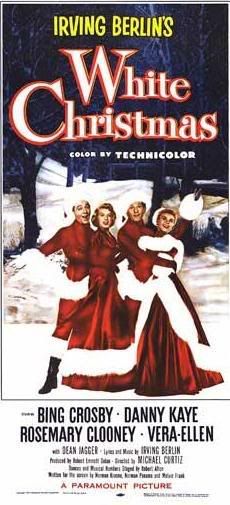
"Irving Berlin's White Christmas" (1954)


we watched irving berlin's classic 1954 film, White Christmas, today on the big screen. it was a delightful experience: the theatre was packed; there were many families there with their kids; and many of those kids, even in their early teens, had never seen the movie before. they laughed at the melodramatic acting, the dance sequences, and often applauded at the end of musical numbers. the whole audience applauded at the end of the movie. and that includes me; i love White Christmas. it is sappy and, to borrow a word from the movie, schmaltzy, but it really doesn't matter; i have to watch it at least once during the season or the year just is not complete.

but something struck me this time that i had not really given a great deal of thought before. the film is a nostalgia-piece. but what is berlin nostalgic for? there remains, today, a large segment of the american population which looks longingly to the 1950's itself as an idyllic age, before the sexual revolution really took hold, before the country lost it's innocence in viet nam, before stonewall, before no-fault divorce destroyed the american family, before the kennedys were murdered, before watergate, and one can go on and on. the 1950's are the "good ole' days". but berlin's film is itself set in the 1950's and he is very clearly already nostalgic for something lost.

this shows up at several points throughout the film. the song and dance number entitled "choreography" mocks the changes that had taken place and the innovations of modern dance. several other numbers recall vaudeville style shows and another large number explicitly harkens back to the "minstrel shows" of the previous generation. but the nostalgia is not simply expressed with respect to the arts; of course artistic and social changes go hand-in-hand. the movie dwells on the theme of the ambition of younger women and how it serves as a destablizing social influence as they pursue careers, refusing to settle down and get married as they used to do. the wacs are praised extensively in another musical number for their dedicated entertainment of the men-folk in a time of war, and care is taken to remind everyone what a great job it was because it was so easy to find a husband.

berlin is nostalgic, then, for the values of the era that predated world war 2. he longs for a return to the glory days of what some have referred to as "the greatest generation". before the war changed everything: snatched youth away from so many young men, snatched women out of their appointed roles and into the work force, turned the world into a place where "everyone has an angle" (the self-interested nature of modern life is also a running theme). and this raises an interesting point. the norman-rockwell-1950's-idealized-americana that remains the dream of many (euphemized under the term "family values") is already a false hope according to berlin. the 1940's had introduced technological and economic innovations that would change the social structure of liberal society irrevocably. the nostalgia for the 1950's is nostalgia for an era that is already itself nostalgic (White Christmas was the top money maker for 1954). one cannot rush back to eden when the supposed-eden has itself, at least according to berlin, already fallen.

the fact is that nostalgia can never reach back far enough to fulfill its desire: to abdicate one's freedom, one's responsibility towards the Future. it is not just an emotion or a whistful feeling, nostalgia represents a fundamental intentionality that one possesses towards the world - one which frees us from responsibility and decision. one no longer needs to make a decision, one no longer needs one's freedom, the decisions were made for us in a previous time. we need simply repeat them anew.

of course nostalgia is undermined by its own desire because it is itself a decision: a free attempt to annul one's freedom, a hope against-hope; it denies faith in History by projecting an anti-Future as the Truth-which-is-our-Future. the dream of a white christmas is the dream about the past; nostalgia longs for that which is dead, instead of turning in hope towards new life.


-LoA

Tuesday, December 19, 2006

when the cold lays siege


Raymond Han, "Studio Still Life #4" (2006)


standing by the car at 3am you left a note of war
in the snow that had fallen for two days straight
the cold laying siege and putting us all in the mood
for blood-letting

you stated a refusal: you would no longer feel
i corrected it
…no longer feel anything other than anger
which made you hate all the more, but being right was my only defense

and what were these wars we fought as the cold laid siege:
over hands that touched me
lies that had been told me
violences that played themselves out on my flesh

wars that had all been fought over my body before
and so were nothing new
i knew the dance of this conflict, had laid down my armor many times in surrender
its rhythm was not unique, its cuts were always mortal

there is no defense for this when the cold lays siege
you shed my blood because it is the only way you can feel
i shed my blood because it keeps me from feeling
and i know that there is no winning this war

-LoA

Monday, December 18, 2006

reflections on being lost

[dedicated to alaleh, baraka, koonj, path2hope and all those others who have that feeling of homelessness]


Umm Aisha, "Grief, Anxiety and Sadness" (2005)


On 20 December 1983 my family was on vacation. It was, in a sense, an odd vacation, and no doubt my parents did not think of it as such, but for me...well, I am a victim of that uniquely modern, liberal and capitalistic phenomenon which Heidegger identifies as homelessness – a failure indicative of a spreading Americanism as far as he was concerned. Homelessness: to be without roots, and thus lost. We had gone home for Christmas after spending the better part of the year abroad in Saudi Arabia. I slept on my grandmother's couch and read Cosmo in the dim light of an old lamp while others slept: issue after issue with absolute fascination: an exposure to something exotic and new.

My parents have always been sure where home was. And they returned there as quickly as possible. Trips there were not vacations, they were returns from exile. But for me, it was never so.

But one wonders if there is not a virtue to homelessness, despite what Heidegger might say. On 20 December 1983 Donald Rumsfeld was shaking the hand of Saddam Hussein. Despite my most cynical moments I do not truly operate under the illusion that Mr. Rumsfeld thought of Hussein as a real ally. I doubt anyone was under any misperception of how reprehensible the leader of the Iraqi Ba'ath party was. But Mr. Rumsfeld knew quite clearly where home was, and this was not it. But he could use Iraq to the interests of his home. When you know where home is, everything outside the door becomes "barbarian" to a greater or lesser degree, and what more can you expect of barbarians than brutality and violence. If Mr. Rumsfeld could, by shaking this hand, aim this particular barbarian at Iran, then that would, by the basic calculus performed by those back at home, be useful. 'Let them kill themselves and we will gladly give them the encouragement and means to do it.' And when the barbarian lord became unruly and was no longer able to be controlled or directed at the right enemy, no longer killed the right people, he could be removed.

I am homeless to Heidegger because I do not unequivocally know where home is. I failed to fully develop the appropriate loyalties; I was not able to draw the distinction, so important to Mr. Rumsfeld's little outing on 20 December 1983, between we-who-are-civilized and they-who-are-barbarians, and so instead I found myself a guest in my grandmother's house no less than I was a guest in Saudi Arabia. I was invited to share Christmas with her much as I had been invited to share in the wonderful nights of Ramadan with my friends in Saudi. There would no longer be a cultural door which I could step through and be finally and decisively at home, though I found myself warmly embraced by many as their guest and neighbor. I have committed that sin, so unforgivable, not only to Rumsfeld but also to Heidegger, of being at home with my homelessness.

-LoA

Saturday, December 16, 2006

weight


Christopher Cousins, "Dark Matter" (2004)


there is your body
the mass: the horror of weight
and there is
the dark: the comfort of weight

i did not need and did not ask for this
this is not what i was promised
the tangle
of lies and madness
the shaping of self so that i could
hide in the dark

-LoA

standing outside the mosque in lahore: the modesty of edwin lord weeks


Jean-Leon Gerome, "The Dance of the Almeh" (1863)


First Delacroix and then his protege, Jean-Leon Gerome, had set the standard for orientalism in the first two thirds of the nineteenth century. What had begun as curious perusals of Arabians and Indians (both Asian and American) in Delacroix, had been elevated to the level of masterpiece size interpretations of Arabia. It was thus no surprise that as the French and English political bodies delved more deeply into this unknown world, painters, fascinated by the stories and colors of the orient turned to Gerome, not only for instruction and guidance but, as the rule by which to judge their own achievements.


And Gerome was indeed a challenge to live up to. Arabia opened up to him and he rendered that Arabia from vantages that had never been seen before: portraying private worship (especially a number of Cairo scenes) both in and outside mosques, the interior of royal courts, and topping Delacroix's lonely odalisques, Gerome was granted entry into the sanctuary of the harem and the baths. These scenes were alive with color and charged with barely contained energy and sexuality. Gerome's Arabia was an exotic and erotic playground for the European imagination. Even as Rousseau had argued for the beauty of a more natural world a generation before, Gerome was portraying the European vision of what nature would look like, absent the civilizing impulse.
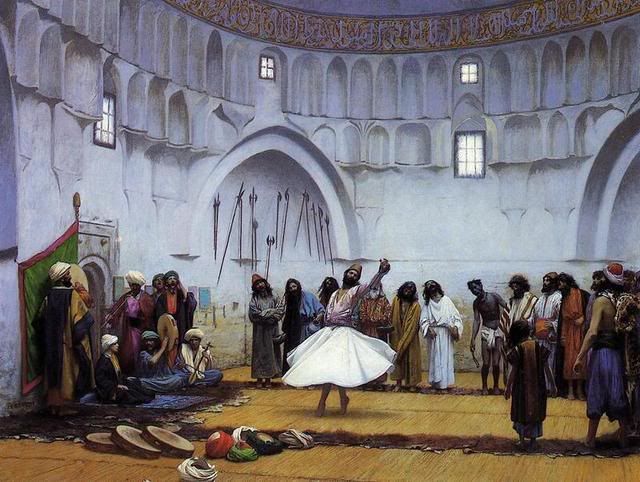

Jean-Leon Gerome, "Whirling Dervishes" (1895)


This visual claim to have laid the Arabian world bare was a key element of Gerome's success. But it was largely a lie. As i have argued before, Gerome does not really grasp Arabia as a whole, but instead divides it into easily consumeable bits, isolated realities that lack a historical or social context. This trend would be followed by the next generation in painters such as Mowbray who unabashedly lays out the orient as a fantasy world lacking depth.


Henry Siddon Mowbray, "Oriental Fantasy" (1887)


The Bostonian, Edwin Weeks, was also among those who sought to learn about the orient and its portrayal from Gerome, but a painter can only learn so much sitting in the studio. So after a time with Gerome and Gerome's close friend Leon Bonnat, Weeks and his new wife decided to venture into Arabia, beginning with Morocco in 1878-79. Weeks rapidly realized they had entered a place which "Gerome had never rendered": confronted by disease (his own and others), famine and hostility, Weeks' work would never be the same.
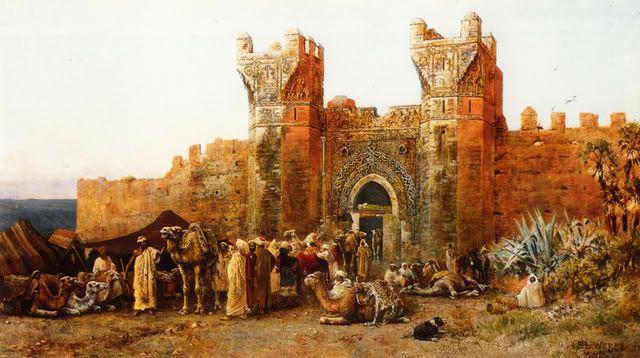

Edwin Lord Weeks, "The Gate of Shehal, Morocco" (1880)


There is something about Weeks' body of work which reveals that he understood he could not lay bare this world to which he was so totally a foreigner. It begins with the modesty with which he described his work. He was a colorist, not an orientalist. He was not someone who could expose the orient to the viewer no matter how long he travelled there (and he did spend a good deal of the remaining twenty years of his life traveling through Persia and colonial India). He demonstrates this both positively, through his chosen subjects and negatively, by what remains unpainted.
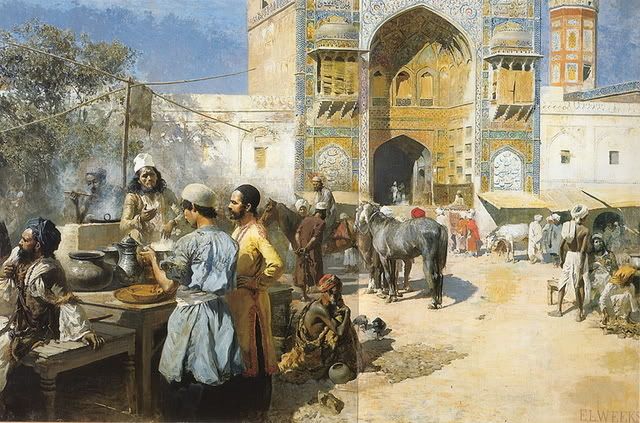


Edwin Lord Weeks, "Open-Air Restaurant, Lahore" (1889)


On the one hand, Weeks generally approached his oriental subjects from the exterior. Weeks has market scenes reminiscent of Gerome's time in Cairo, but also palaces that are viewed from their courtyards, or from outside their walls, and heads of state, but only as they travel through the city. This self-enforced vantage point can be seen in two of Weeks' paintings of the mosque at Lahore. In the first, "Riders in front of the Mosque in Lahore" there is a gathering of men around the steps of the mosque. They are immersed in conversation, some of them moving either into or out of the mosque itself, others sitting in the sun and of course the gathering of riders. The European viewer toward whom the painting is directed is not granted the intimacy of entering this circle; one is neither included nor given clues about what the gathering portends. One is outside, not only the circle of men but the world itself. The mosque towers above, leaving the top edge of the canvas in a manner that suggests its overwhelming character. In the second painting, "An Open-Air Restaurant, Lahore", Weeks places the viewer in a more accessible setting. The need for food, cooking and selling, are all realities the viewer can make sense of, but once again, the mosque still looms in the background. Weeks emphasizes that even with the help of greater perspective, a touch-point in something recognizeable, the mosque, and all it symbolizes, is still uncontainable by his gaze, and it once again overwhelms the viewer in its majesty. One cannot completely grasp the world one has entered here, and Weeks refuses to provide the illusion that one can.
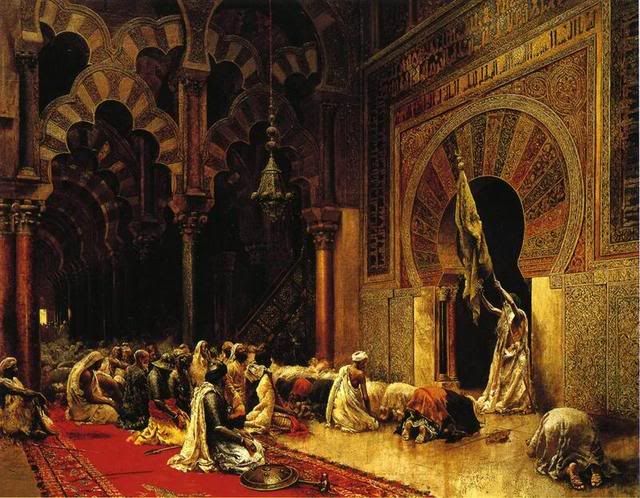

Edwin Lord Weeks, "The Interior of the Mosque at Cordova" (1889)


The exceptions to this general practice by Weeks only confirm this idea. Weeks' great mosque interior, which shows men at prayer, is "The Interior of the Mosque at Cordova". Here a few things must be pointed out. First, Weeks chooses to render the interior of a mosque that is on European soil. And while the painting is historical in its content, the title is minimalist. Weeks uses the title to call attention only the mosque interior, reminding the viewer of the history of the building now known in another form. His historical renderings of the Moorish period in Spain, of which the mosque at Cordova is a part, show him willing to enter into hypothesis concerning the interior of Muslim life only at the point in which that life overlapped with European history. And there is no better icon of that overlap than the mosque at Cordova as his viewers would have well known. The historical scenes he renders must be set between the 10th and 11th centuries for once the Christians re-occupied Cordova, the mosque itself was transformed into the city cathedral. Moreover, when need for a larger cathedral arose, they built a magnificient gothic structure that rose dramatically out of the center of the mosque, melding Christian and Muslim architecture and history together in a unique manner. Here is a place, if there is such a place, says Weeks, where one can enter into a mutual understanding with Islam because Europeans share in this moment as a piece of their own history. There is a part of this story he has the tools to understand and render.

This brings us to the final point concerning Weeks' modesty. Unlike Gerome's work, Weeks' is striking in the lack of harems, baths, prostitutes, courtesans, and even the interior of royal courts with the fanciful animals that Gerome portrayed. This cannot be attributed to lack of access. As Weeks notes, the Muslim world was so open and friendly to his arrival in northern colonial India that he had to flee his friends in order to get work done. They showered him with models (human and animal) to paint at his request, to the point where it was necessary to hide to get them sketched and painted. Weeks' decision then is a conscious one. The drama of the private lives of the men and women of the orient were, once again, mysterious to him - not in the manner of being something fantastic, but in the sense of having their own ethic and language in which he could not pretend to be fluent. These were pieces of a puzzle that Gerome had been content to take individually, but which Weeks recognized as part of a whole which he, as yet, could not see. Their lives were not the stuff of European exoticism, but had a reality and depth that Weeks did not know how to penetrate and about which he refused to lie. As he expresses again and again in his paintings, Weeks knew he was standing at the exterior and that the exteriority must remain; there had to be modesty, if there was ever to be a real intimacy of understanding.


-LoA
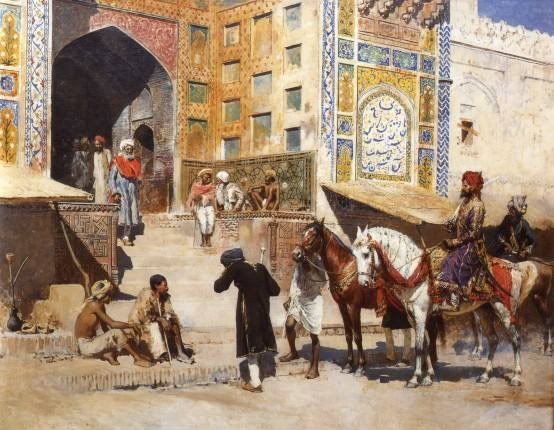

Edwin Lord Weeks, "Riders in front of the Mosque at Lahore" (1889)
Friday, December 15, 2006

the struggle, part 6


Felice Sharp, "Markers" (2006) [mixed media on board]


faith is the belief that in and through human activity something more gives itself; a commitment to the idea that there will be a fullness of Truth; that this fullness is the implicit promise carried in the experience of meaning (this is what makes faith a rational hope). it is faith precisely because this fullness is not-yet. thus the object of faith is the Truth-which-is-our-Future.

the claim of faith: out of the Old the New will impossibly emerge.

Truth is not something that simply is. Truth is not a collection of facts. Truth presents itself in and through human activity and because of this one never simply has the Truth. it is instead encountered in the various ways in which human beings examine the question of meaning, and so it is presented with all the partiality and brokenness of humanity. this is the origin of the struggle: humanity's constant attempts to come to the fullness of meaning, the Whole, that is promised in all they do. Truth is not held in the past, nor does it exist as a timeless present as if it were an already fulfilled reality. Truth is the Future which must be realized. This is why History is Truth. we experience Truth as that which is about to come.

hegel claimed that the True was the Whole. adorno countered this with the claim that the Whole is the False. but these two claims are not in conflict with one another. for hegel, Truth could only be known from the standpoint of the fullness of History. adorno reminds us that in the midst of History all claims to possess such knowledge already are occult. claims to grasp what that might be, or to insist that one knows the plan or practice by which progress toward Reconciliation might be certainly achieved is the height of >undialectical= or >uncritical= thinking. it can only serve the interest of whatever totem is raised as a banner of salvation, shutting humanity off from any hope for the Future. today Truth is crucified and broken, and thus all claims to Wholeness, Holiness, Peace or Reconciliation are ideology and mystification. adorno is the truth of hegel as seen in the middle of History.

in the present all writing must make clear that it is an exercise in productive failure.

-LoA

Wednesday, December 13, 2006

ecstasy


Robert Ryman, Untitled (1965)


When Levinas argues in his early essay, “On Escape”, that human desire is not a sign of lack, he seems to be making a radical break with the tradition, both theological and philosophical. The insufficiency of what we have and the need for more, something that could satisfy it, had been a crucial aspect of philosophical theology from Augustine to Maimonides to al-Farabi. We move, are driven by desire, because we want something. But Levinas is not really making as radical a break as it might seem, for what Levinas is here arguing is that humanity does not find its end in itself. When one searches within the given being of human existence one is always left unsatisfied; our natures mock us, hang about us like a weight, keeping us riveted to our own dis-satifaction. While other finite natures find their fulfillment in their own natural capacities, this is untrue of humanity. Fish gotta swim, birds gotta fly, pens gotta write, but humanity must ....nothing. It is not, then, that there is something we lack, instead we need to get out of the very thing we have, indeed we need to escape all having. The erotic drive is the unquenchable desire for transcendence. So when Levinas tells us that there is a disquiet at the heart of humanity that manifests itself naturally as the desire for escape, he is saying humanity cannot be content in its own finitude. Humanity is incapable of achieving its own happiness, and so will be content with nothing less than a breakthrough that it is incapable of bringing about on its own. Here in fact Levinas is advocating a position that can be found throughout the Platonic tradition. Desire can only be satisfied by the Good which is beyond all being and every nature. We are only truly ourselves in ecstasy, that is to say, quite literally, in going-out of ourselves.

Sunday, December 10, 2006

i am marie antoinette

here i sit in my castle, the world a disordered mess. we like to pretend that we are just ordinary folk, "middle class", as if the privelege of being the bougeoisie were indeed normal. but i am not really that confused. the truth is that we are the aristocracy, floating above it all until the masses decide they have had enough. there will be another french revolution and i will be found guilty. ought i to "give away all [i] have to the poor" so i might be poor too? no, the game of 'voluntary poverty' is the manner by which those who are wealthy go out to mock the poor in the very homes and streets in which they struggle to make lives. the poor do not want more poverty, they want justice. since they cannot have justice they will take us to the guillotine instead: treason against humanity. guilty? oh indeed guilty. but here i sit in my castle, the world a disordered mess. what else do i have to give them: "let them eat cake".

-LoA

faith (an engagement with karl barth's cd i/1 §1.3)

faith and hope point beyond the present moment and thereby recognize that the Truth is not yet realized in its wholeness. thus faith is the orientation of one’s action towards the Truth-which-is-our-Future. our lives must be lived out of that engagement with the Truth. and yet, just as Truth is not some past event, something given as a fact and possessed to be used as a tool, neither is faith something we can have as our own for it is only given as Truth gives itself in freedom. faith, then, is the event in which humanity is made the mediation of the Truth-which-is-its-Future. this must be insisted against every humanism. because there is nothing which humanity does not receive as gift, one can hardly talk of the Future as the highest impulse of human self-realization. of itself, humanity is nothing and humanism is nihilism: the empty pride of insisting on our own being. the Truth cannot be realized as something that humanity possesses, but as that which claims all of humanity as its own. no method can master the Truth in its free character as event. it is never ours, but takes us as its own by the gift of faith.

-LoA

Friday, December 8, 2006

the struggle, part 5 (fallen)


Marten Valkenborch, "The Tower of Babel" (16th c.)


everywhere we seek reconciliation and find only alienation.

there is only the one sin: to insist that 'I am'. everything else is its symptom.

we do not live in the land of Truth, but we are haunted by it. Truth slips between the shadows of the trees in the night, we hear its sound on the wind, see its footprints in the morning dew. By day it threatens, dancing like a fire among the branches, never revealing itself, but frightening us just the same. we worry that it will come for us: we who banished it. we worry it will pierce us to the heart.

we have built our tower; it stretches to heaven. we named its walls Eternity, and on its foundation engraved the word Nature. let Ramses look upon it and despair.

in babel, we speak only one language; by law every sentence must include the word "I".

History is Truth.

-LoA

Thursday, December 7, 2006

notes on elizabeth nourse's arabia (the mosque at tunis)


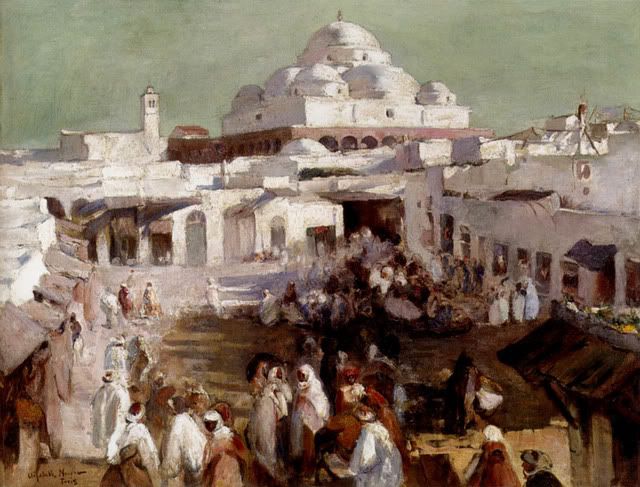
Elizabeth Nourse, "The Mosque, Tunis" (1897)


It is widely observed that Elizabeth Nourse's portrayal of women in real social settings marked a break with her contemporaries, especially men such as, her mentor, Jules Joseph Lefebvre. In Lefebvre aestheticism combined with the male gaze to produce abstract portraits of mostly nude women, absent any setting, without meaning, emptied of their content and of their very person. This allowed the female form to be taken in solely as an object of pleasure. Nourse's women, on the other hand, usually existed in household scenes, often with their children, in a manner that resisted the easy reification of the female body for the male viewer because they were embedded within social narratives that affirmed their vitality and humanity.


Jules Joseph Lefebvre, "Girl with a Mandolin" (late 19th c.)


I would like to suggest that we should read Nourse's "The Mosque, Tunis" in a similar fashion, once again against the tendency of the Orientalist tradition of most of her colleagues. If one takes her near contemporary Gerôme as an example one quickly sees the extremely dis-integrated vision of Arabia that he possesses. Apart from his fantasies of the Oriental harems and a few pictures of prostitutes, Gerôme's Arabia is nearly absent of women, revealing the extent to which the Orient was a playground for the European male's imagination of exotic and rampant sexuality. There are likewise portraits of isolated men: guards, merchants, traders, soldiers, or rulers. And finally there are a set of paintings that focus on Islamic prayer. These are particularly noteworthy relative to our theme as one compares Gerôme's vision to that of Nourse. Gerôme's pictures are either tightly framed or enclosed within the interior of the mosque which provides a backdrop to emphasize the alien nature of the event to the European viewer. He fails to make any connection between these religious acts and any other aspect of the society which he is "realistically" portraying, just as he fails to integrate the persons, both male and female, into their society. These are isolated objects, commodified persons and events packaged for easy consumption and playing to the tastes and expectations of the viewer.


Jean-Léon Gerôme, "The Call to Prayer" (1866)


Nourse's painting operates at a much different and more ambitious level than any thing Gerôme dared attempt. She encompasses a much fuller breadth of Islamic society within one vision and likewise understands the direction or goal that provides the interior dynamic to social life. A large group of people are portrayed going about a variety of tasks, men and women, spread throughout the square, walking to different parts of the city, as the larger city looms behind the market. Over it all, the mosque draws one's focus from the market higher toward that which stands at the center and pinnacle of the social and political life of its inhabitants and defines the rhythms of their day.


Mark Rothko, Untitled (1953)


And just as she produces a picture of an integrated society, she also integrates her use of color into the overall purpose of the painting. One is led upward from the darkness of the lower corner to the height of light. The painting is essentially organized into three fields of color. The lower right corner ranges from very dark to earth tones (this placement of the market within shadow is itself possibly a bit of critique). The top third is a gray-blue sky that extends as one long band. Finally one is led by the light strip at the far left out of the dark shadows of the market upwards through the city until the dome of the mosque pierces through the gray and into transcendence over everything else. The transcendence of the mosque is only emphasized by what might count as a fourth field of color, the small band of pink stone that secures the preeminence of the mosque over all else. In this way, while the concrete content of the painting provides the panorama of an integrated world, it is the use of color itself that provides the narrative direction. Here, Nourse anticipates not only the social realist movement (for which she is often given credit in her paintings of women), but in her use of vast fields of color to invoke the movement towards transcendence she likewise anticipates later abstract expressionists such as Rothko.

-LoA


Elizabeth Nourse, "The Sewing Lesson" (1895)